


What Is Shot Blasting? Why It Matters for Powder-Coated Metal Outdoor Furniture?

For B2B buyers, this matters because coating failure rarely begins with color. It usually begins with preparation.

1. What Is Shot Blasting?
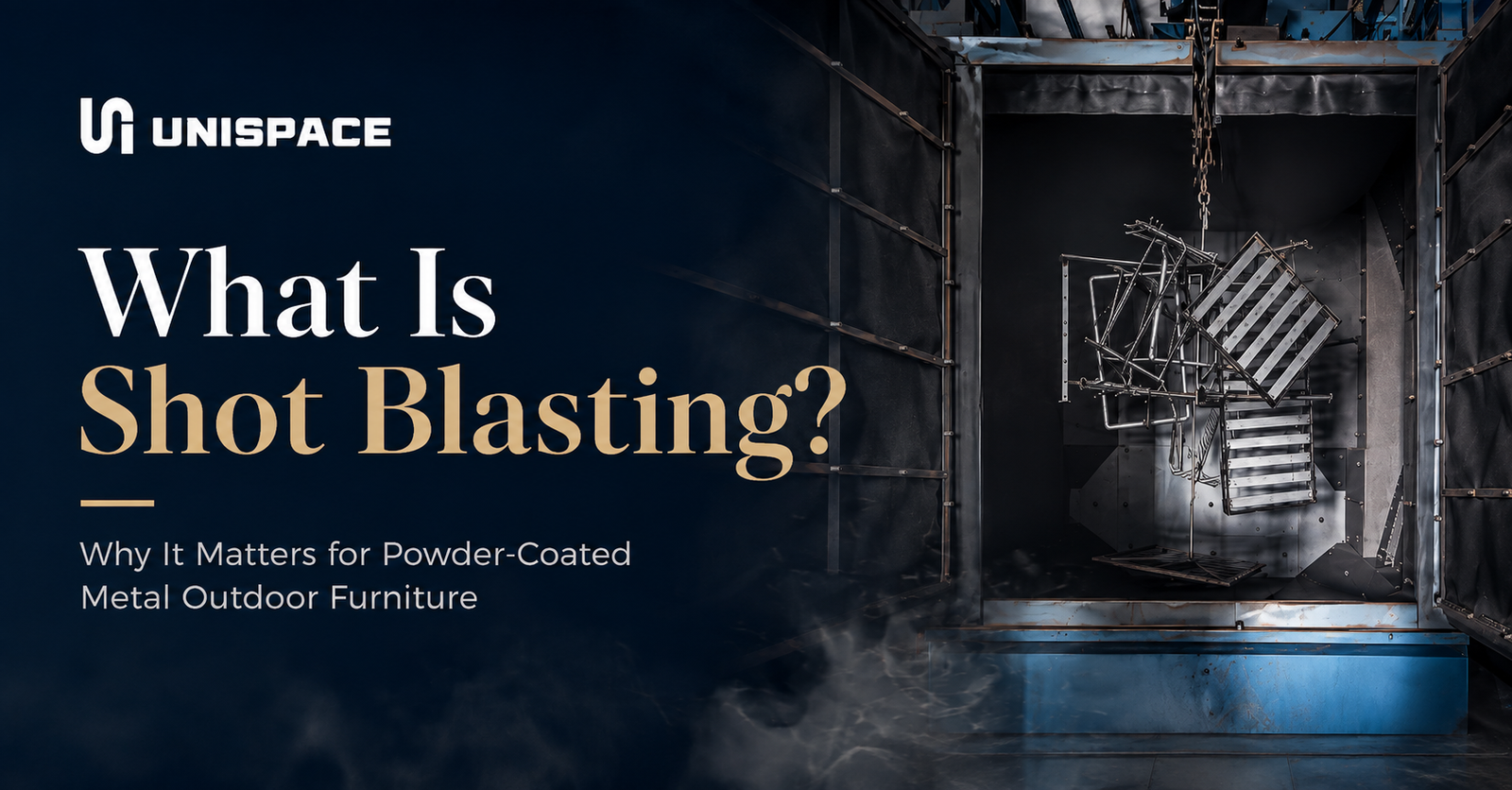
Shot blasting is a mechanical surface-preparation process in which abrasive media is projected at high speed onto a metal surface.
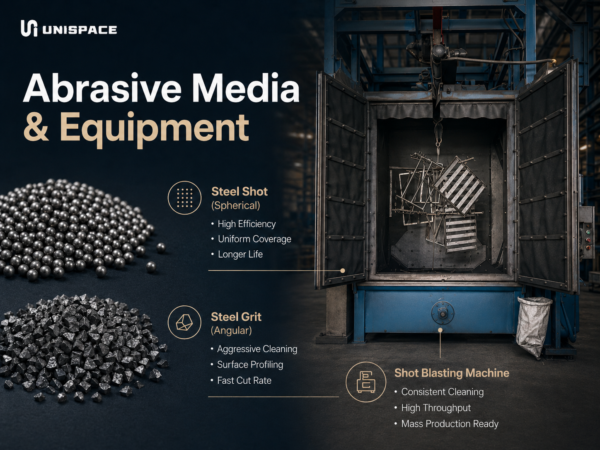
Depending on the equipment and process requirements, the abrasive may include metallic shot or grit. When the media impacts the steel surface, it can remove:
- rust;
- oxidation;
- mill scale;
- welding residue;
- loose contamination;
- certain surface defects.
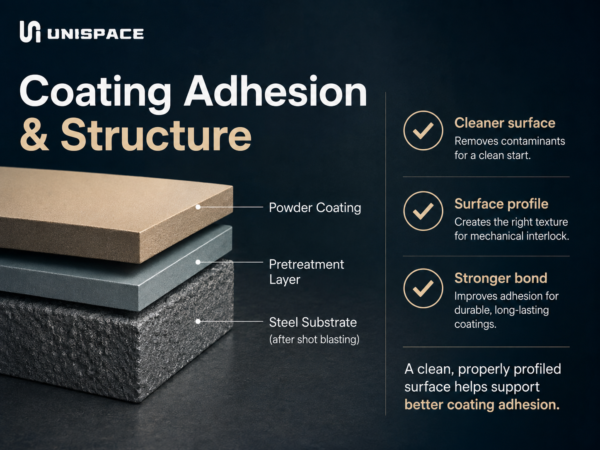
At the same time, the process creates a more uniform surface profile. This is important because a coating does not simply need a metal surface that “looks clean.” It needs a surface that is sufficiently clean and appropriately prepared for the next finishing process.
For a metal outdoor furniture manufacturer, shot blasting can therefore serve as an important bridge between frame fabrication and surface finishing.
2. Why Surface Preparation Matters Before Powder Coating
Many buyers focus on powder type, coating thickness and color. Those factors matter, but powder coating adhesion begins before powder is sprayed.
Imagine applying a high-quality powder coating onto a steel frame that still contains loose mill scale, oxidation, welding contamination, grease or unstable surface residue. The coating may initially look acceptable, but the interface between coating and substrate is already compromised.
Over time, this may contribute to:
- coating delamination;
- blistering;
- localized corrosion;
- rust starting around damaged areas;
- premature coating failure.
For outdoor furniture, this becomes particularly important because products may experience repeated exposure to moisture, temperature changes, UV, cleaning and physical abrasion.
Surface preparation is therefore not a cosmetic step. It is part of the coating system.
3. What Does Shot Blasting Actually Remove?
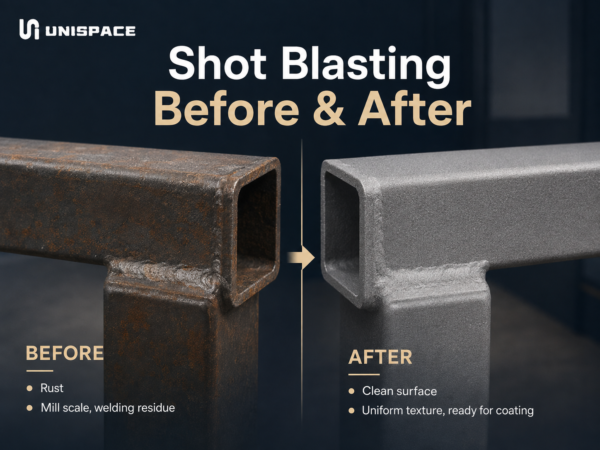
One of the main advantages of shot blasting is that it mechanically removes surface material that may interfere with later finishing.
| Surface Condition | Why It Matters |
|---|---|
| Rust | Can continue corrosion underneath a coating |
| Mill scale | May reduce coating reliability if poorly bonded |
| Welding oxidation | Can create inconsistent coating areas |
| Surface residue | Can interfere with adhesion |
| Uneven surface condition | May produce inconsistent finishing results |
Shot blasting can also help create a more consistent surface texture. This surface profile gives the following coating system a better-prepared substrate.
The exact cleanliness level required depends on the product, coating system, customer specification and corrosion environment. The more useful question is not simply “Do you shot blast the frame?” but “What surface condition are you trying to achieve before coating?”
4. How Shot Blasting Fits Into Outdoor Furniture Production
A typical steel outdoor furniture production flow may look like this:
Tube Cutting → Bending → Welding → Grinding → Shot Blasting / Surface Preparation → Pretreatment → Drying → Powder Coating → Curing → Inspection → Assembly → Packaging
The exact sequence can vary by outdoor furniture factory and product. Shot blasting normally comes after major fabrication work has been completed because welding and grinding themselves change the metal surface.
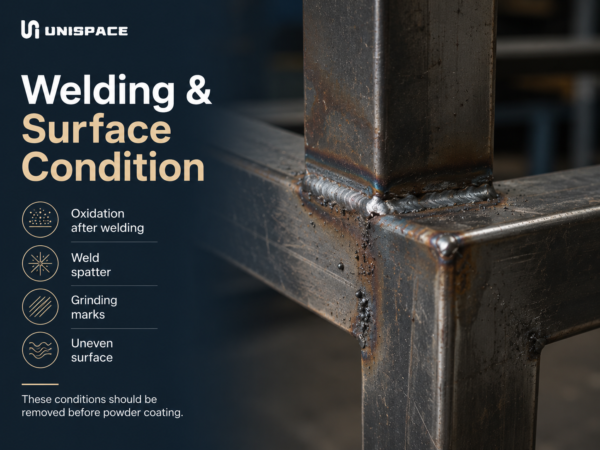
During welding:
- heat creates oxidation;
- weld areas differ from the surrounding tube;
- grinding exposes fresh metal;
- spatter or residue may remain around joints.
If the frame goes directly into coating without consistent surface preparation, different parts of the same chair may react differently during finishing.
For an outdoor furniture factory, process consistency matters more than simply owning the machine. Important variables include abrasive condition, blasting intensity, exposure time, frame positioning, surface coverage, cleaning after blasting and the time between blasting and subsequent treatment.
5. Shot Blasting Is Not the Same as Grinding
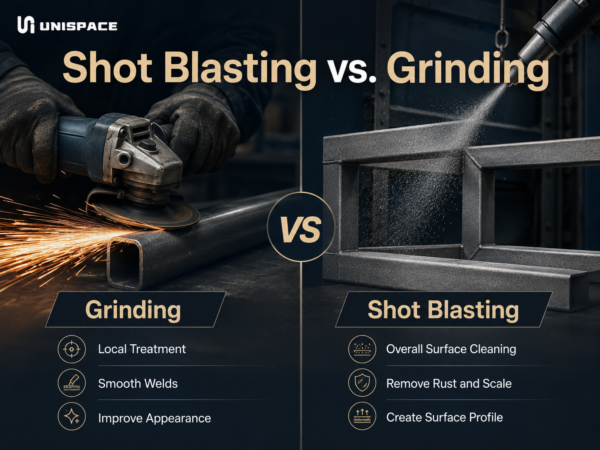
This is a common misunderstanding. Grinding and shot blasting perform different functions.
Grinding
Grinding is usually used locally. It can:
- smooth welds;
- remove sharp edges;
- improve appearance;
- correct localized imperfections.
A worker may grind one weld until the joint looks clean, but grinding does not necessarily prepare every external surface of the frame consistently.
Shot Blasting
Shot blasting treats a much larger surface area. Its purpose is not only to make the frame visually smooth. It is primarily a controlled surface-cleaning and preparation process.
Grinding shapes the local surface. Shot blasting prepares the overall surface.
In good outdoor furniture production, the two processes can complement each other rather than replace each other.
6. Shot Blasting Is Not a Replacement for Chemical Pretreatment
Shot blasting is a mechanical treatment. Chemical pretreatment serves different functions and can include processes designed to clean the substrate and improve corrosion resistance or coating performance.
Depending on the factory’s coating system, product specification and target market, the process may combine:
Mechanical preparation + Chemical pretreatment + Powder coating
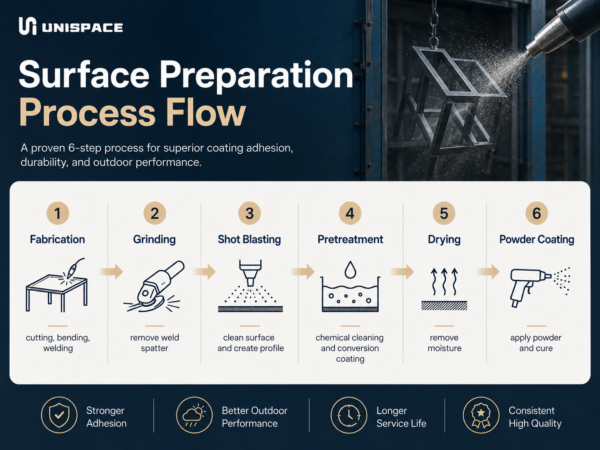
A typical sequence may be:
- Frame fabrication is completed.
- Welds are ground and cleaned.
- The frame is mechanically prepared.
- Remaining contamination is removed.
- The surface receives the required pretreatment.
- The frame is dried.
- Powder is applied.
- The coating is cured under controlled conditions.
The complete system matters more than one individual machine. Buyers evaluating powder coated metal outdoor furniture should therefore ask about the entire surface-treatment sequence.
7. How Shot Blasting Affects Powder Coating Quality
A properly prepared metal surface supports several important production goals.
1. More Consistent Surface Cleanliness
Fabricated steel components do not always arrive at the coating stage in identical condition. Shot blasting helps create a more uniform starting surface.
2. Improved Mechanical Surface Profile
A controlled surface profile can help support coating adhesion. However, rougher is not automatically better. The surface profile still needs to be compatible with the coating system.
3. Removal of Unstable Oxides and Scale
Loose or poorly bonded material underneath a coating creates a weak interface. Removing it reduces one source of coating failure.
4. Better Consistency Around Welded Areas
Outdoor furniture frames contain many welded joints. These areas may have very different surface conditions from untouched tubing. Consistent preparation helps reduce that variation.
5. Better Foundation for Later Pretreatment
Mechanical cleaning can help prepare the frame for subsequent finishing stages. This is one reason surface preparation should be viewed as a process chain rather than an isolated operation.
8. What Can Go Wrong During Shot Blasting?
Shot blasting is not automatically a sign of high quality. A poorly controlled blasting process can create its own problems.
Over-Blasting
Excessive blasting can create an unnecessarily aggressive surface, increase processing time, increase media consumption and affect thin components.
Incomplete Coverage
Complex chair frames contain tube intersections, inner corners, underside surfaces, weld junctions and narrow gaps. If only the easy-to-reach areas are treated effectively, the result may still be inconsistent.
Poor Media Condition
Abrasive media changes during repeated use. Its condition, size distribution and contamination level can influence process consistency.
Dust or Residue After Blasting
A blasted surface still needs to be handled correctly. Residual dust and contamination can interfere with subsequent processes.
Waiting Too Long Before the Next Process
Freshly prepared steel surfaces can begin reacting with the environment. The process flow between blasting, pretreatment and coating should therefore be controlled.
The goal is not simply to blast the frame. The goal is to maintain the prepared surface condition until coating is completed.
9. Shot Blasting vs. Sandblasting: Are They the Same?
The terms are sometimes used interchangeably in casual conversation, but they are not always technically identical.
Shot blasting commonly refers to abrasive media being mechanically projected, often through wheel-blast equipment. Sandblasting generally refers to abrasive blasting using compressed air.
In manufacturing discussions, it is better for buyers to ask about:
- abrasive media;
- equipment type;
- surface-cleanliness target;
- surface profile;
- production consistency.
These details are more useful than relying only on the name of the process.
10. What Should B2B Buyers Check?
When sourcing powder coated metal outdoor furniture, buyers can ask the manufacturer several practical questions.
Surface Preparation Checklist
- What condition is the steel in before coating?
- Are welded frames mechanically cleaned before pretreatment?
- Is shot blasting used for all products or selected structures?
- How are corners, welds and difficult areas treated?
- How is blasting consistency controlled?
- What happens between blasting and chemical pretreatment?
- How is the frame protected from contamination after preparation?
- What powder coating system is used afterward?
- How is coating thickness checked?
- How are adhesion and coating appearance inspected?
- How are scratches and coating damage prevented during packing?
These questions reveal much more than simply asking, “Do you have a powder coating line?”

11. Shot Blasting Is One Part of a Larger Quality System
A durable outdoor coating does not come from one machine. It comes from a controlled sequence.
For steel outdoor furniture, that sequence may involve:
Material Selection → Welding Quality → Grinding → Surface Preparation → Pretreatment → Powder Application → Curing → Inspection → Packaging
If one part is weak, the final coating system may be affected. Perfect powder application cannot fully compensate for poor surface preparation. Good surface preparation cannot compensate for incorrect curing. And even a good coating can be damaged by poor packaging.
This is why outdoor furniture quality control must look at the entire process rather than only inspecting the finished color.
Final Recommendation
For B2B buyers, shot blasting is not something that needs to be specified on every single outdoor furniture product. But buyers should understand why the process exists.
The purpose is not to make steel look more industrial. It is to create a controlled surface before finishing.
For powder coated metal outdoor furniture, that preparation can influence coating adhesion, corrosion risk, production consistency and long-term appearance.
A reliable manufacturer should therefore be able to explain:
- what surface condition is required;
- why a certain preparation method is used;
- how the process is controlled;
- how it connects with pretreatment and powder coating;
- how final coating quality is inspected.
The most important question is not:
“Does your factory have a shot blasting machine?”
It is:
“How does your surface-preparation system help produce consistent outdoor furniture at scale?”

Looking for a Metal Outdoor Furniture Manufacturing Partner?
UNISPACE supports OEM and ODM outdoor furniture projects with metal fabrication, surface preparation, powder coating, quality control and export packaging.