Outdoor Sectional Sofa Buying Guide: Modular Layouts, Sizes and Materials

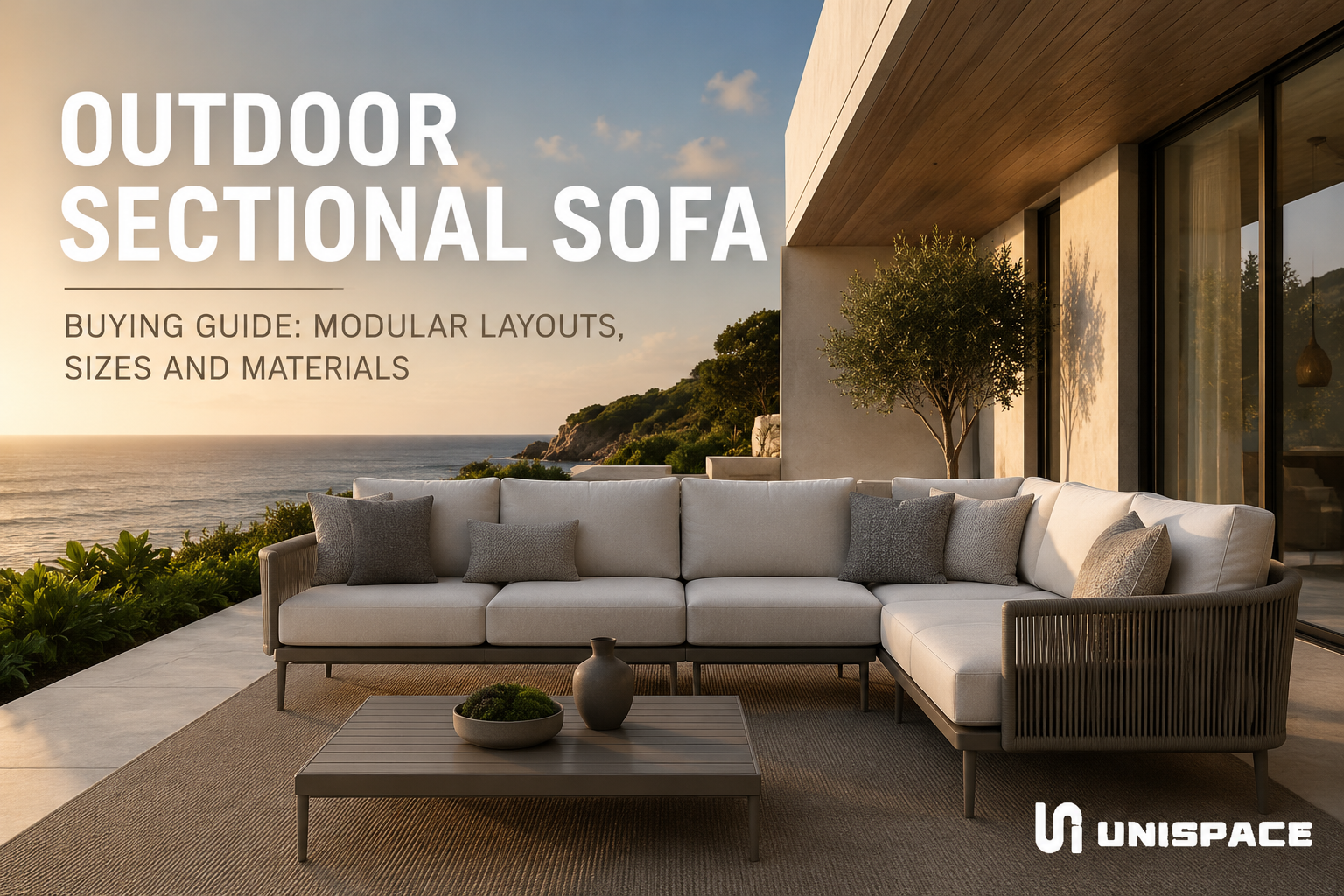
Choosing the right outdoor sectional sofa is not only about appearance. For B2B buyers, it affects seating capacity, layout flexibility, packaging volume, container loading, replacement modules, and long-term after-sales risk. This guide explains how to evaluate modular layouts, standard sizes, materials, and OEM options before placing a wholesale or project order.
Quick Contents
- What Is an Outdoor Sectional Sofa?
- Sectional vs. Modular Outdoor Sofa
- Common Outdoor Sectional Sofa Configurations
- Standard Outdoor Sofa Dimensions
- How to Choose the Right Layout
- Small Outdoor Corner Sofas for Compact Spaces
- Frame, Fabric and Cushion Materials
- Commercial vs. Residential Outdoor Sectionals
- Packaging and Container Loading Considerations
- OEM and Custom Modular Sofa Options
- Final Recommendation
1. What Is an Outdoor Sectional Sofa?
An outdoor sectional sofa is a multi-seat outdoor seating system made from separate sofa units. Instead of one fixed sofa, it is usually built with corner units, armless middle units, left-arm units, right-arm units, chaise modules, ottomans, or matching coffee table modules.
For residential users, the main value is flexible layout. For importers, wholesalers, furniture brands, and project buyers, the value goes further: one product family can serve different markets and spaces through multiple combinations.
From a manufacturing perspective, a good sectional design is not simply several seats placed together. Each module must match in seat height, depth, cushion size, frame angle, connector position, and packaging logic so that the product can be assembled, shipped, and reordered reliably.
2. Sectional vs. Modular Outdoor Sofa
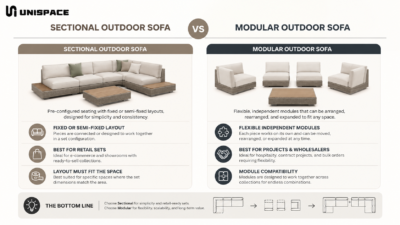
The terms sectional and modular are often used together, but they are not exactly the same. A sectional sofa outdoor product usually has a defined layout, such as an L-shape, U-shape, or corner arrangement.
A modular outdoor sofa is more flexible. It is made from independent units that can be rearranged, expanded, or reordered. This is useful for B2B buyers who need different configurations for different customers, projects, or sales channels.
| Type | Main Feature | Best For | Buyer Concern |
|---|---|---|---|
| Outdoor sectional sofa | Fixed or semi-fixed layout | Patios, villas, retail sets | Layout fit |
| Modular outdoor sofa | Flexible independent units | Projects, brands, wholesalers | Module compatibility |
| Outdoor sofa set | Sofa with table or ottomans | E-commerce and retail | SKU planning |
| Custom sectional | OEM layout and dimensions | Hotels and resorts | Sampling and MOQ |
3. Common Outdoor Sectional Sofa Configurations
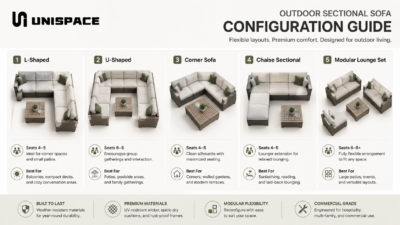
Common configurations include L-shaped layouts, U-shaped layouts, corner sofas, chaise sectionals, and modular lounge sets. An L-shaped layout is the most common choice for patios, gardens, and poolside areas, while a U-shaped layout works better for hotels, resort lounges, and larger terraces.
For wholesale programs, buyers should define whether each module can be sold separately. If a customer wants to replace one armless unit or add one corner unit later, module compatibility becomes a real selling point.
| Configuration | Typical Seating | Suitable Space | B2B Notes |
|---|---|---|---|
| L-shaped sectional | 4-6 people | Patio, terrace, garden | Strong retail potential |
| U-shaped sectional | 6-10 people | Resort, hotel, large deck | Higher packaging volume |
| Corner sofa | 3-5 people | Compact patio, balcony | Good for small spaces |
| Chaise sectional | 3-6 people | Poolside, residential lounge | Lifestyle-focused design |
4. Standard Outdoor Sofa Dimensions
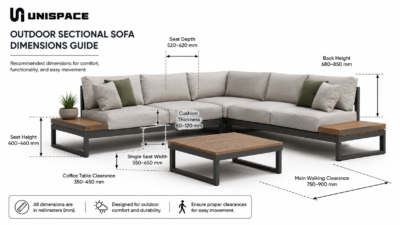
Outdoor sofa dimensions directly affect comfort, packaging size, container loading, and project suitability. A sofa that looks good in a catalog may feel too deep for dining use, too low for older users, or too large for apartment balconies.
Small changes in depth or module width may affect carton size and final landed cost. A 650 mm middle unit may look more generous than a 580 mm unit, but across a 40HQ shipment, the larger carton can reduce loading efficiency.
| Dimension Item | Common Range | Notes |
|---|---|---|
| Seat height | 400-460 mm | Comfortable for most lounge seating |
| Seat depth | 520-620 mm | Deeper seats feel more relaxed |
| Back height | 680-850 mm | Higher backs provide support |
| Single seat width | 550-650 mm | Affects seating capacity |
| Cushion thickness | 80-120 mm | Depends on foam and fabric |
| Coffee table clearance | 350-450 mm | Important for daily use |
| Main walking clearance | 750-900 mm | Useful for commercial spaces |
5. How to Choose the Right Layout
The right layout depends on usable space, traffic flow, seating purpose, and target market. A residential patio needs comfort and visual warmth. A restaurant terrace needs durable structure, easy cleaning, and efficient floor use. A hotel lounge needs a more premium appearance and stronger long-term performance.
Buyers should confirm left-facing and right-facing versions before sampling. For sectional products, left and right layouts are a common source of ordering mistakes. Clear drawings, module codes, and assembly instructions reduce this risk.
6. Small Outdoor Corner Sofas for Compact Spaces
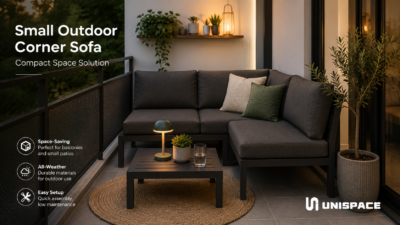
A small outdoor corner sofa is useful for compact patios, balconies, apartment terraces, and small cafes. It creates more seating than two separate chairs while keeping the space visually organized.
A typical compact corner layout may use two or three modules, with an overall footprint around 1800-2400 mm on the long side. Seat depth may stay around 550-600 mm to balance comfort and space efficiency.
7. Frame, Fabric and Cushion Materials
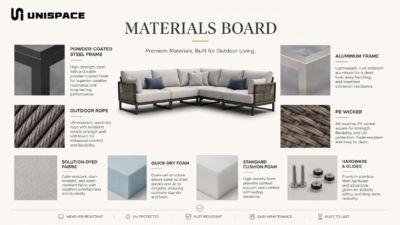
Material selection determines long-term performance. The main components include the frame, surface material, cushions, fabric, feet, connectors, and hardware. For frames, powder-coated steel and aluminum are widely used.
Steel offers strong rigidity and good cost control, especially for modular structures that need stable connections. Aluminum is lighter and naturally resistant to red rust, which is useful for coastal or lightweight product programs.
For steel frames, buyers should check tube specifications, welding quality, grinding, pretreatment, powder coating, drainage holes, and replaceable feet. A typical outdoor powder coating thickness is commonly around 60-100 um, and common steel tube wall thickness may range from 0.8-1.5 mm depending on product positioning.
| Component | Common Options | What Buyers Should Check |
|---|---|---|
| Frame | Steel, aluminum | Tube size, welding, coating |
| Surface | Rope, PE wicker, metal slats | UV resistance and tension |
| Cushion | Standard foam, quick-dry foam | Thickness and drainage |
| Fabric | Polyester, Olefin, solution-dyed fabric | Color fastness and water resistance |
| Hardware | Connectors, glides, screws | Rust resistance and replacement |
8. Commercial vs. Residential Outdoor Sectionals
Commercial and residential outdoor sectionals may look similar, but their requirements are different. Residential buyers usually care more about style, comfort, and cushion softness. Commercial buyers care more about structure, cleaning, replacement parts, repeat orders, warranty risk, and high-frequency use.
For commercial projects, metal frames are often practical because they provide stable structure and repeatable production. For retail programs, an outdoor sectional sofa set should also be easy to photograph, describe online, pack, and assemble.
| Application | Main Priority | Recommended Focus |
|---|---|---|
| Residential patio | Comfort and appearance | Soft cushions, warm design |
| Hotel lounge | Premium look and durability | Strong frame, better fabric |
| Restaurant terrace | Space efficiency and cleaning | Upright seating, easy maintenance |
| Rooftop bar | Wind and exposure resistance | Stable weight, durable coating |
| Retail program | Price and SKU flexibility | Modular SKUs, carton control |
9. Packaging and Container Loading Considerations
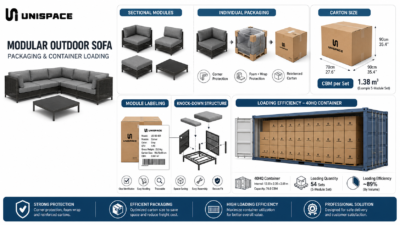
Packaging is one of the most important but often overlooked parts of sectional sofa purchasing. A large sofa may look profitable by unit price but become expensive after carton volume, loading quantity, and damage risk are considered.
Modular products can improve shipping flexibility only if the modules are designed with packaging in mind. Oversized corner units, thick cushions, and non-stackable frames may increase CBM quickly.
Buyers should ask for product dimensions, carton dimensions, net and gross weight, CBM per set, estimated 40HQ loading quantity, cushion packing method, and protection for corners, legs, and coating surfaces.
| Packaging Item | Why It Matters |
|---|---|
| Carton size | Affects CBM and freight cost |
| Cushion compression | Saves space but must recover well |
| Frame stacking | Improves loading efficiency |
| Corner protection | Reduces coating damage |
| Module labeling | Helps assembly and after-sales service |
10. OEM and Custom Modular Sofa Options
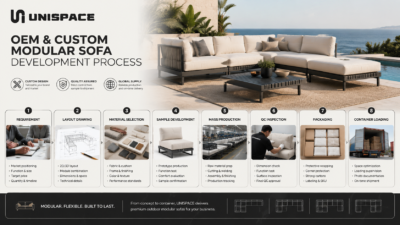
OEM and custom modular sofa development is important for brands, wholesalers, and project buyers. A modular system can be adjusted by size, frame color, fabric, cushion thickness, rope style, wicker type, armrest shape, and coffee table combination.
However, customization should be controlled. Too many unique modules can increase mold cost, sampling time, production complexity, and spare part confusion. A better approach is to develop a core module system first, then extend it with selected options.
For long-term buyers, module compatibility should be documented through drawings, part codes, connector positions, cushion codes, and replacement module rules. Without this, repeat orders may not match earlier shipments.
| Custom Item | Possible Options | Manufacturing Impact |
|---|---|---|
| Frame size | Width, depth, height | Affects jigs and carton size |
| Frame finish | Powder coating colors | Affects MOQ and lead time |
| Cushion | Thickness, fabric, piping | Affects comfort and cost |
| Layout | L-shape, U-shape, chaise | Affects SKU planning |
| Packaging | KD, semi-assembled, full set | Affects loading and assembly |
11. Final Recommendation
An outdoor sectional sofa is more than a large seating product. For B2B buyers, it is a product system involving layout, dimensions, material selection, packaging, container loading, and future reorder compatibility.
For most wholesale and project programs, the best choice is a modular system with stable frame engineering, clear module codes, practical outdoor sofa dimensions, durable outdoor materials, and packaging designed from the beginning.
When comparing suppliers, do not only ask for the unit price. Ask for module drawings, carton data, material specifications, coating details, assembly method, and customization options. A professional manufacturer should help buyers evaluate both the visible design and the hidden structure behind the sofa.
Manufacturer Buying Checklist
| Checkpoint | What to Confirm |
|---|---|
| Layout | L-shape, U-shape, chaise, corner, or modular set |
| Dimensions | Seat height, depth, back height, module width |
| Frame | Steel or aluminum, tube size, welding quality |
| Coating | Pretreatment, coating thickness, drainage design |
| Cushions | Thickness, fabric, foam, drainage performance |
| Modules | Left/right version, connector position, replacement rules |
| Packaging | Carton size, CBM, protection, loading quantity |
| Customization | Color, fabric, rope, wicker, layout, private label |