What We Learned About Outdoor Furniture at Furniture China 2026

What We Learned About Outdoor Furniture at Furniture China 2026
A Manufacturer’s View on Global Design, Materials, Comfort and the Real Cost Behind Outdoor Furniture
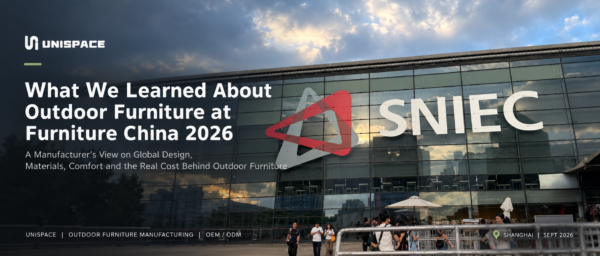
Furniture China 2026 brought together finished furniture, original design, materials, equipment and manufacturing supply chains across Shanghai. For an outdoor furniture manufacturer, that makes the show useful for more than product inspiration: it is a place to compare how different markets turn design ideas into commercially viable products.
This year, our attention was mainly on outdoor furniture — from outdoor sofas and lounge chairs to patio furniture, garden furniture, woven collections, metal frames and synthetic materials.
We tend to look at these products from two angles at once. We see the design, but we also look at tube specifications, bending radii, welding points, support geometry, cushion construction, KD potential, packing volume and whether a showroom sample can be repeated consistently in mass production.
The most useful takeaway was therefore not a list of “2026 best sellers.” It was a clearer view of how product value is being built — and where different market segments are moving in very different directions.
The right question is not simply: What is trending? It is: What kind of product actually fits the market?
Quick Contents
- 01. You Can Usually See Where the Cost Goes
- 02. Market Positioning Should Come Before Supplier Selection
- 03. Outdoor Furniture Is Becoming More Indoor
- 04. Moss Green and Terracotta Are Moving Outdoor Furniture Beyond Black and Grey
- 05. The Rattan Look Is Staying, but the Material Logic Is Changing
- 06. Homogeneity Remains the Biggest Risk in the Value Segment
- 07. Comfort Reveals What Product Photos Can Hide
- 08. The Most Eye-Catching Showpiece Is Not Always the Best Mass-Production Product
- 09. For Buyers, Trends Are Inputs — Not Product Strategy
- 10. What We Actually Bring Back to the Factory
01. You Can Usually See Where the Cost Goes
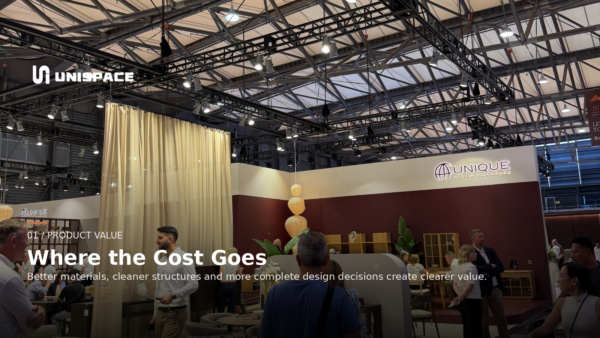
One of the clearest impressions from the show was that strong mid- and high-end products usually reveal where the money has been spent. The difference is rarely one expensive material. It is a series of decisions: better frame proportions, cleaner tube bending, more refined upholstery, stronger material transitions, better finishing and a noticeably better seating experience.
Some premium designs clearly do not put maximum container loading efficiency at the top of the brief. A curved outdoor sofa may not break down like a conventional KD product. A sculptural chair may require more bending operations, welding, jigs and fixtures. A continuous frame may not stack or nest efficiently.
Those choices become real manufacturing cost — materials, labor, tooling, packaging and sometimes freight — but they can also preserve a stronger design identity.
The important point is not that expensive furniture is always better. A high-cost product can be right for one market, while a tightly engineered value product can be right for another. The cost structure has to match the market it is meant to serve.
02. Market Positioning Should Come Before Supplier Selection
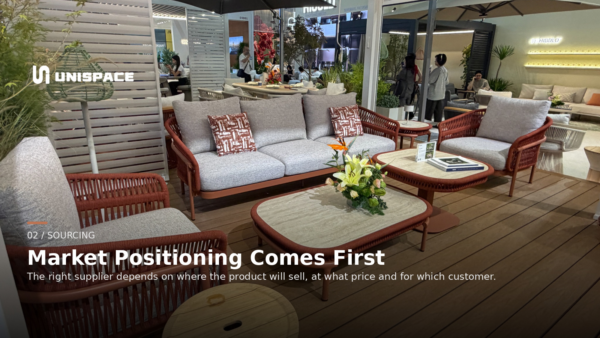
This may be the most important sourcing lesson from the show. There is no single definition of the “best” outdoor furniture supplier because different factories are optimized for different products, price bands and business models.
A design-led premium brand may prioritize originality, material tactility, structural refinement, comfort, finishing and visual identity. More complex construction, higher material cost and lower container utilization may still make sense because the customer is buying a complete product experience.
Mass retail, e-commerce, chain stores and price-sensitive wholesale channels operate under a different equation. Target FOB price, packing volume, container quantity, assembly time, transport risk, repeatability and after-sales cost become much more important.
Market Positioning × Product Positioning × Target Cost × Manufacturing Capability
For outdoor furniture sourcing, these four elements need to align. A mature OEM/ODM manufacturer should not simply say “yes” to every request. The more useful role is to identify which design features should stay, which structures can be simplified, which materials can be substituted and where engineering can reduce cost without reducing the value the customer is actually buying.
03. Outdoor Furniture Is Becoming More Indoor
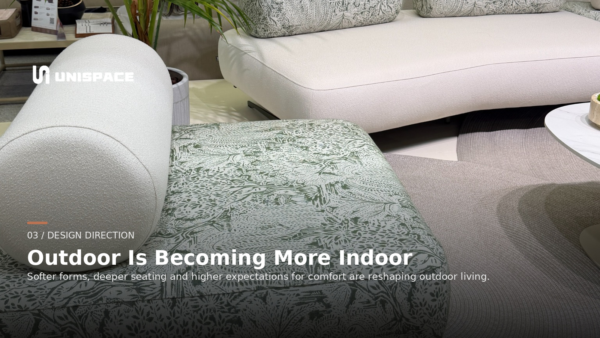
One of the strongest design directions at the show was the continued indoorization of outdoor furniture. Traditional garden furniture and patio furniture were developed first around weather resistance, durability, maintenance and controllable cost. Those requirements remain, but more indoor-furniture language is moving outdoors.
We saw deeper seats, fuller cushions, softer silhouettes, richer fabric textures, decorative pillows and more complete lifestyle settings — especially in outdoor sofa collections.
Balconies, terraces, gardens, pool areas and hospitality spaces are increasingly treated as extensions of the interior. The question is no longer only, “Can this stay outdoors?” It is also, “Why shouldn’t outdoor furniture feel as comfortable as indoor furniture?”
That creates a harder engineering problem. Looking soft is easy. Feeling soft while still meeting outdoor requirements for drainage, corrosion protection, mildew resistance, maintenance and long-term use requires the structure, materials and cushioning system to work together.
04. Moss Green and Terracotta Are Moving Outdoor Furniture Beyond Black and Grey
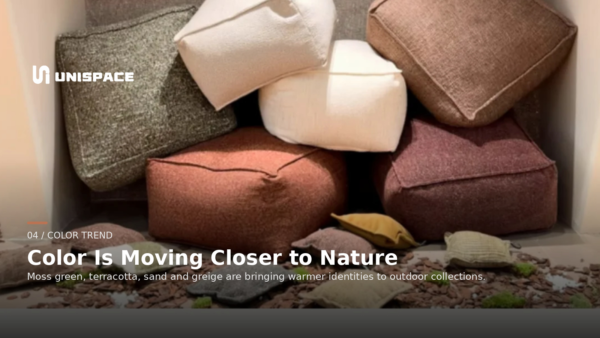
Black, charcoal and cool greys are still important, but more collections are moving toward warmer, nature-based palettes. Two directions stood out repeatedly: Moss Green and Terracotta, often combined with sand, greige, warm beige, cream, natural brown and softer wood tones.
These colors make sense outdoors because the furniture already sits among plants, stone, timber, soil and sunlight. On metal outdoor furniture, warmer earth tones also reduce the industrial feeling of the frame.
The same structure can read as modern-industrial in matte black, warmer and more lifestyle-oriented in terracotta, or more integrated with a garden setting in moss green.
For product development, color is therefore becoming more than a finishing option added at the end. It increasingly needs to be considered as part of the product identity from the beginning.
05. The Rattan Look Is Staying, but the Material Logic Is Changing
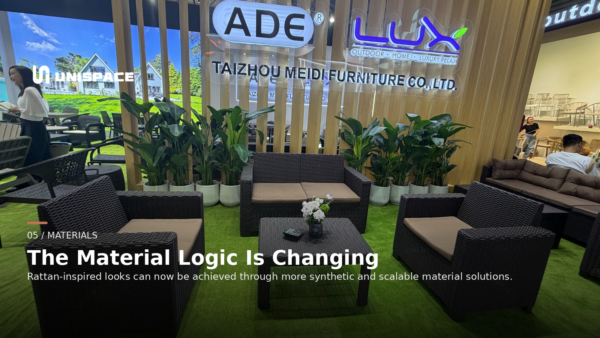
Another interesting observation came from products that looked like conventional woven rattan at first glance. On closer inspection, some used molded plastics, composites or other synthetic solutions designed to reproduce a woven or rattan-like surface.
PE rattan itself is not new. What is changing is the sophistication of polymer processing, surface texture and color variation. Some synthetic surfaces can now create more convincing depth and irregularity, reducing the obvious “plastic” look from a distance.
This matters because hand weaving and rope weaving remain labor-intensive processes. If a product can retain the visual language of weaving through a more scalable forming process, mid-market and value-oriented patio furniture sets may gain a new cost-engineering route.
That does not mean plastic is replacing woven furniture. High-quality rope and hand weaving still offer tactile depth, craftsmanship and perceived value. The more important change is that product developers now have more material pathways to achieve a similar visual language.
06. Homogeneity Remains the Biggest Risk in the Value Segment
As we moved from design-led booths toward more price-driven outdoor collections, product similarity became very obvious. Similar frames, arms, weaving patterns and tables were repeatedly refreshed through a new color, cushion fabric or small dimensional change.
Individually, these products can look perfectly acceptable. But when dozens of comparable collections are viewed together, the commercial weakness becomes clear: they are easy to substitute.
When Product A and Product B feel interchangeable, price becomes the easiest comparison. Once competition moves almost entirely to price, the remaining places to reduce cost are limited: tube specification, fabric weight, foam, support structure, hardware, surface preparation, coating, packaging and sometimes quality control.
Low-cost furniture is not automatically poor furniture. The important distinction is Engineering Cost Down versus Quality Cost Down. Mature manufacturing should reduce cost through structure optimization, material utilization, standardization, automation, KD design and smarter packaging — not simply by removing quality.
07. Comfort Reveals What Product Photos Can Hide
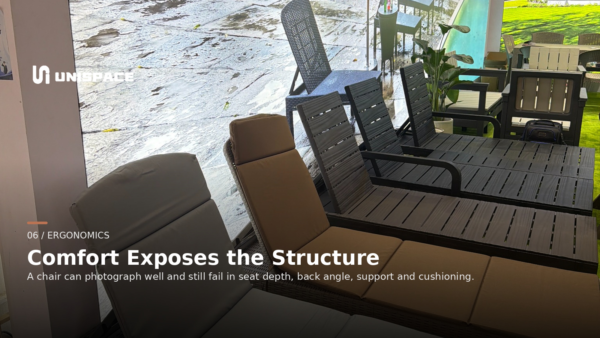
One of the biggest advantages of a trade show is that you can actually sit on the furniture. We tried several loungers, lounge chairs and sofas that looked good from a distance but revealed problems immediately in use.
Some back angles felt unnatural. Some products lacked lumbar support. Some had poor relationships between seat depth and back height. In a few cases, the cushion looked thick enough, yet the metal support behind it could still be felt.
Product photography can hide structural weaknesses; the human body usually cannot.
Comfort is not simply a matter of adding more foam. It depends on seat height, seat depth, back angle, arm height, lumbar position, frame curve, bottom support, suspension, foam density, resilience and cushion thickness. If the frame geometry is wrong, a thicker cushion often adds cost without solving the real problem.
For outdoor lounge chairs, chaise lounges and outdoor sofas, comfort should be engineered from the frame stage — not repaired at the end.
08. The Most Eye-Catching Showpiece Is Not Always the Best Mass-Production Product
A trade show rewards visual impact. Mass production rewards repeatability. International sourcing adds a third requirement: logistics efficiency.
A beautiful chair may need multiple bending operations. A fluid sofa frame may require significantly more welding. A sculptural structure may not nest. A fully assembled product may look excellent but use container space very poorly.
None of those decisions are automatically wrong. They simply belong to a different business model.
Design × Manufacturing × Cost × Logistics
A mature OEM/ODM outdoor furniture project needs to balance all four. Design without manufacturing can create a beautiful sample that cannot be repeated consistently. Manufacturing without design creates generic products. Cost without value drives a price war. Logistics without design pressure eventually makes every product look like the same KD solution.
09. For Buyers, Trends Are Inputs — Not Product Strategy
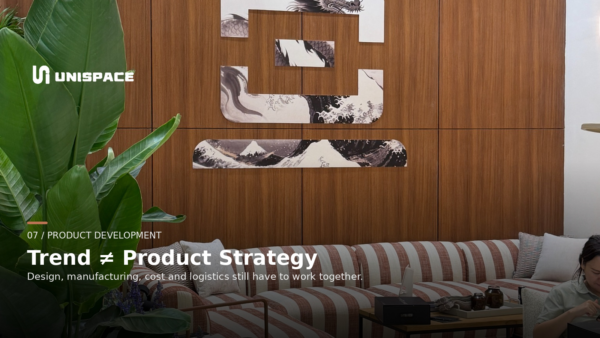
Trade shows naturally create a temptation to copy what appears frequently. Terracotta is visible, so develop terracotta immediately. Oversized sofas are everywhere, so make everything oversized next season. Synthetic rattan improves, so replace traditional weaving.
Trend ≠ Product Strategy.
A product succeeds because of who buys it, where it sells, the target retail price, the value the consumer will pay for, the expected product life, the target FOB, the landed cost and whether the supply chain can reproduce it consistently.
The same trend should produce very different products in different markets. The goal of attending a furniture show is therefore not to copy what everyone is doing, but to understand why the market is moving that way.
10. What We Actually Bring Back to the Factory
For an outdoor furniture manufacturer, the best result of a furniture show is not a folder of products to copy. Copying the most common designs would only increase market homogeneity.
The useful questions are different: Why does this product look more refined? Why does the same steel tube look lighter in this frame? Why is one chair clearly more comfortable? Why does this material create a different level of perceived value? Why is a simple structure still memorable?
After this show, we will continue to study several directions: natural colors such as terracotta, moss green, sand and greige; new synthetic and molded material solutions; comfort engineered from the frame stage; structural differentiation through proportion, bending, welding and material combinations; and cost optimization that removes waste without removing product value.
Good engineering is not about removing everything that costs money. It is about removing unnecessary cost while protecting the value the customer actually buys.
Final Thought: There Is No Universal “Best” Outdoor Product
Furniture China 2026 reinforced something we see every day in manufacturing: product quality is rarely created by one expensive material. It is created by many small decisions.
A slightly better bending radius. A back angle that is a few degrees more comfortable. A cleaner weld. A material better suited to the use case. Foam with the right resilience. A smarter KD structure. Packaging that loads more efficiently without damaging the product.
Together, those details determine whether a piece of furniture simply looks good — or whether it is a mature product.
There is also no universal definition of the “best supplier.” Premium markets require one product logic; mass markets require another. Design brands and large retailers may need completely different things from their supply chains.
Outdoor furniture will continue to adopt new colors, materials and design languages. But the manufacturing question remains the same: how do we turn a good idea into a product that is attractive, comfortable, reliable, repeatable at scale and commercially viable for the market it is meant to serve?
A good supplier is not simply the factory that can make the highest-spec product. It is the one that understands what level of product your market actually needs.
— UNISPACE
Outdoor Furniture Manufacturing · OEM / ODM Development