The 3 Biggest Outdoor Furniture Problems Designers Face — and Practical Solutions


The 3 Biggest Outdoor Furniture Problems Designers Face — and Practical Solutions
Choosing among commercial outdoor furniture suppliers is rarely a simple sourcing task for designers. A sample can look convincing, yet the project may still fail through inconsistent mass production, unsuitable materials, or unclear after-sales responsibility. For hospitality and contract projects, the real question is not whether the furniture photographs well, but whether the supplier can convert design intent into repeatable, serviceable, and commercially workable products.
1. Why Good-Looking Samples Are Not Enough
Designers often stand between the client, contractor, purchaser, and manufacturer. When the delivered furniture differs from the approved sample, the designer becomes the first person asked to explain the problem, even when the root cause sits in production control. This is why supplier selection should be treated as part of design risk management rather than as a final purchasing step.
Retail buyers may focus on appearance, unit price, delivery speed, and online reviews. Wholesale and project buyers need a different logic: batch consistency, documented specifications, lead-time control, replacement compatibility, packaging volume, warranty responsibility, and the supplier’s ability to support future reorders. A reliable outdoor furniture supplier must therefore be evaluated as both a product source and a project partner.
2. Problem 1: The Sample Looks Good, but Mass Production Fails
A good sample does not guarantee consistent mass production. Samples are normally made with closer supervision, more manual correction, and fewer time pressures. During bulk production, variation can appear in tube bending, welding position, grinding quality, frame squareness, rope tension, cushion fullness, color matching, and hardware installation. The risk increases when specifications exist only in chat messages instead of controlled drawings, approved samples, and signed material standards.
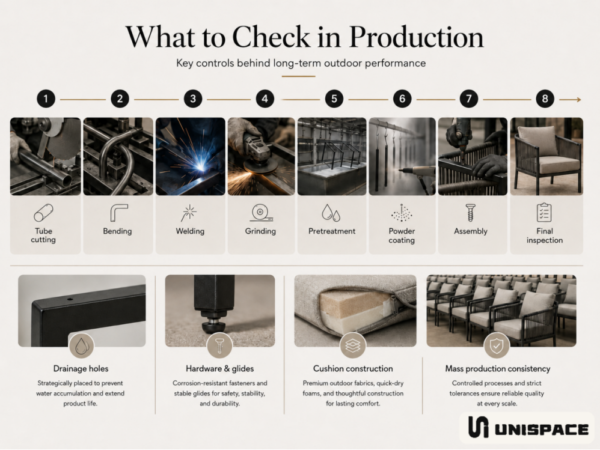
Before approving an outdoor furniture manufacturer, ask how the factory controls the transition from prototype to production. Useful evidence includes an engineering drawing with tolerances, a signed golden sample, a bill of materials, pre-production meeting records, in-line inspection points, and a final inspection standard. The goal is not to create paperwork for its own sake; it is to make the product repeatable across hundreds of units and across future seasons.
| Control Area | What to Verify | Hidden Risk |
|---|---|---|
| Engineering release | Drawings, tolerances, BOM, golden sample | Different teams produce different interpretations |
| Process control | Bending jigs, welding fixtures, grinding standard, in-line QC | Shape variation, unstable dimensions, visible defects |
| Capacity and planning | Real production schedule, subcontracting disclosure, material readiness | Late delivery or rushed final production |
| Batch consistency | Color limits, fabric lot control, rope tension, cushion templates | Sample quality cannot be repeated in bulk |
3. Problem 2: Limited Material and Process Knowledge
Designers do not need to become factory engineers, but they do need enough material knowledge to challenge unsuitable recommendations. The correct specification depends on climate, exposure, usage frequency, maintenance capacity, target price, and expected service life. A powder-coated steel frame may be commercially sensible for a covered restaurant terrace, while aluminum may be preferable for coastal projects where weight and corrosion resistance are priorities. Neither material is automatically superior in every application.
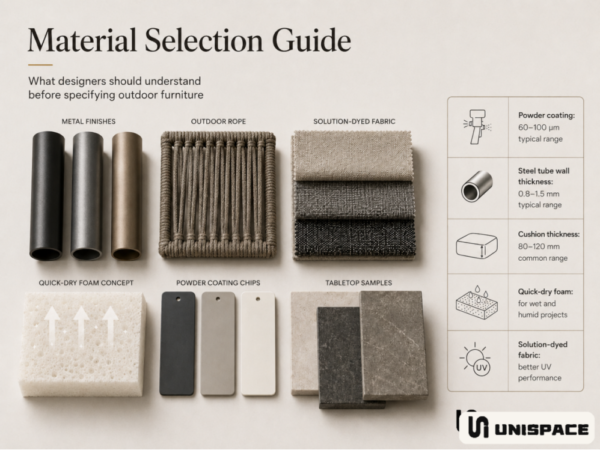
For metal frames, tube size and wall thickness should be selected together with span, load path, welding design, and target weight. A common steel tube wall thickness is approximately 0.8–1.5 mm, but the correct value is project-dependent. Powder coating is commonly specified in a typical range of about 60–100 μm, provided the pretreatment, curing, edge coverage, and drainage design are also controlled. Coating thickness alone cannot compensate for poor surface preparation.
| Component | Typical Reference | Designer Checkpoint |
|---|---|---|
| Seat geometry | Seat height 400–460 mm; depth 520–620 mm | Confirm comfort with actual cushion compression, not frame dimensions alone |
| Frame and coating | Steel wall 0.8–1.5 mm; coating 60–100 μm, project-dependent | Ask about pretreatment, drainage holes, weld sealing, and curing records |
| Cushion system | Common thickness 80–120 mm | Specify foam density, drainage method, inner liner, zipper, and fabric performance |
| Rope or wicker | UV-resistant outdoor grades | Check material specification, colorfastness, tension standard, and repair method |
| Project clearance | Table gap 350–450 mm; main walkway 750–900 mm | Validate circulation after the final module configuration is fixed |
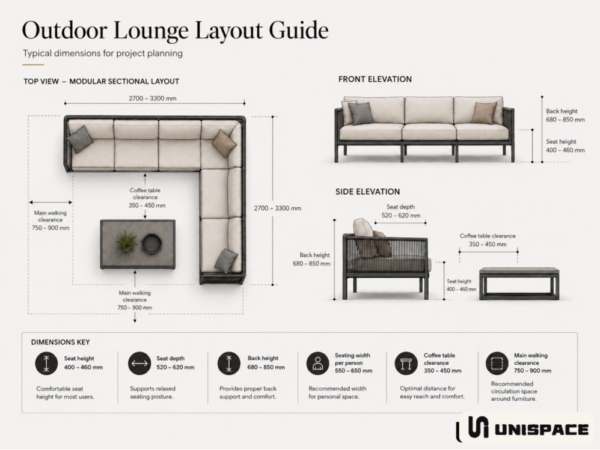
Cushion construction deserves equal attention. A thickness of roughly 80–120 mm is common for lounge seating, but comfort depends on foam density, layer structure, seat suspension, cover pattern, and compression under use. Quick-dry or reticulated foam is useful for wet and humid applications, although it increases cost and still requires breathable fabric, drainage, and suitable maintenance. For exposed projects, solution-dyed fabric generally offers stronger UV performance than surface-dyed alternatives.
4. Problem 3: After-Sales Responsibility Is Unclear
After-sales problems become expensive when responsibilities are vague. A client reports corrosion, a loose connector, a faded rope panel, or a collapsed cushion; the designer contacts the purchaser, the purchaser contacts the supplier, and the supplier asks for information that was never recorded. The delay damages trust even before the technical cause is confirmed.
Warranty terms should define coverage, duration, exclusions, evidence requirements, response time, and remedy. A practical agreement also separates structural frame issues from coating, fabric, rope, cushion, hardware, and misuse. For outdoor contract furniture, the remedy may involve spare parts, replacement modules, repair instructions, credit, or a jointly agreed inspection. The correct solution depends on failure type, order value, shipping cost, and project urgency.
- Define the warranty start date and the exact duration for each component.
- State which photos, batch numbers, labels, and inspection records are required for a claim.
- Agree on response times, technical analysis steps, and the person responsible for escalation.
- Keep spare hardware, glides, connectors, rope, fabric, and color references for repeat orders.
- Define whether the remedy is repair, parts replacement, module replacement, credit, or refund.
5. Supplier Evaluation & Manufacturer Checklist
The most effective solution is a repeatable supplier evaluation system. Avoid relying on a single sample, a polished showroom, or a low quotation. Evaluate the supplier across engineering capability, process control, capacity, communication, documentation, packaging, and after-sales performance. The score should be updated after sampling, pilot production, and the first bulk order rather than completed only once.
| Buyer Type | Primary Concern | Supplier Evidence |
|---|---|---|
| Retail buyer | Appearance, price, delivery, reviews | Product photos, packaging, stock plan, customer service |
| Wholesaler / importer | Batch consistency, margin, loading, reorders | QC records, carton data, container plan, stable BOM |
| Hospitality / contract buyer | Durability, compliance, project schedule, replacement | Material specs, tests, mock-up, warranty and spare-part plan |
| OEM / ODM buyer | Engineering feasibility, IP, development cost, scalability | Drawings, prototypes, tooling plan, costed BOM and change control |
Manufacturer Checklist
- Confirm controlled drawings, tolerances, BOM, golden sample, and signed change records.
- Identify factory-owned and subcontracted processes, including the responsible quality controls.
- Review bending and welding fixtures, in-process inspection points, grinding standards, and batch traceability.
- Verify pretreatment, powder-coating controls, drainage holes, fasteners, glides, and cushion specifications.
- Request carton dimensions, protection details, assembly instructions, and a preliminary 40HQ loading plan.
- Define warranty evidence, spare-part availability, response times, remedies, and future reorder compatibility.
A factory visit is useful, but the visit should follow a checklist. Observe whether bending fixtures are identified, welds are controlled before grinding hides them, pretreatment tanks are maintained, powder-coated parts are protected from collision, cushion templates are standardized, and finished goods are traceable by batch. These details reveal more than a prepared meeting room.
6. Packaging, Loading, and Replacement Compatibility
Packaging is not a secondary detail; it affects FOB cost, container efficiency, transit damage, installation, and replacement orders. Fully assembled furniture may offer stronger visual integrity and simpler installation, but it normally uses larger cartons. Knock-down structures can improve loading efficiency, yet poor connector design may reduce stability, create visible fasteners, or make on-site assembly difficult.
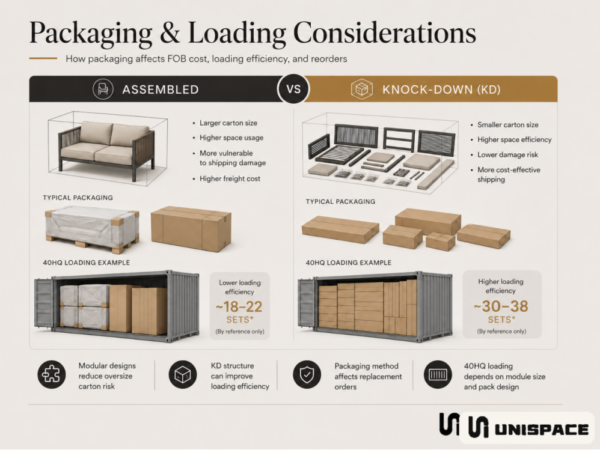
For modular outdoor furniture, each module should have a stable code, left- and right-hand definitions, controlled connector positions, and a packaging record. This allows a damaged corner, armless seat, or side panel to be replaced without reshipping the entire set. It also helps brands reorder successful modules in later seasons. Carton dimensions, protective materials, stacking direction, and mixed-set loading should be reviewed before final pricing because they can change total landed cost substantially.
7. OEM, ODM, and Modular Project Planning
Customization is becoming more important in hospitality and branded retail projects, but custom does not simply mean changing a color. Designer outdoor furniture custom sizing may require new tube lengths, revised angles, cushion patterns, connector positions, load paths, cartons, and testing. Every change should be evaluated for comfort, strength, manufacturability, tooling cost, minimum order quantity, production lead time, and replacement compatibility.
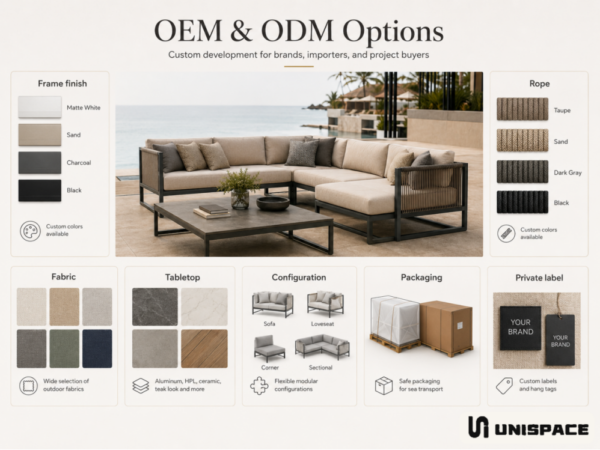
A well-planned OEM outdoor furniture manufacturer or ODM program begins with a design brief, target market, target price, expected order volume, application environment, and packaging objective. The manufacturer can then propose frame materials, tube specifications, modular logic, coating systems, fabrics, rope or wicker options, tabletops, hardware, and testing requirements. This process is more reliable than asking for a quotation from a reference photo alone.
In hospitality and branded retail projects, buyers increasingly request adaptable layouts, custom finishes, and modular systems that can serve multiple space plans. For designers, modularity should therefore be planned before sampling rather than added after the product is complete. Module width, connector logic, left- and right-hand versions, cushion interchangeability, packaging, and future reorder compatibility should be developed as one coordinated system.
8. Final Recommendation
Do not wait for a failure to discover that the supplier system was incomplete. Start with three controls: build a documented supplier scorecard, learn the material and process basics relevant to the project environment, and sign clear warranty and after-sales terms before production. For high-value hospitality, wholesale, and OEM projects, request an engineering review before sampling and a packaging review before final pricing. The best supplier is not the one that promises the most; it is the one that makes responsibilities, specifications, and production risks visible early enough to manage them.