Why Outdoor Chair Designs Fail in Mass Production | Manufacturer Guide

1. From Good-Looking to Manufacturable
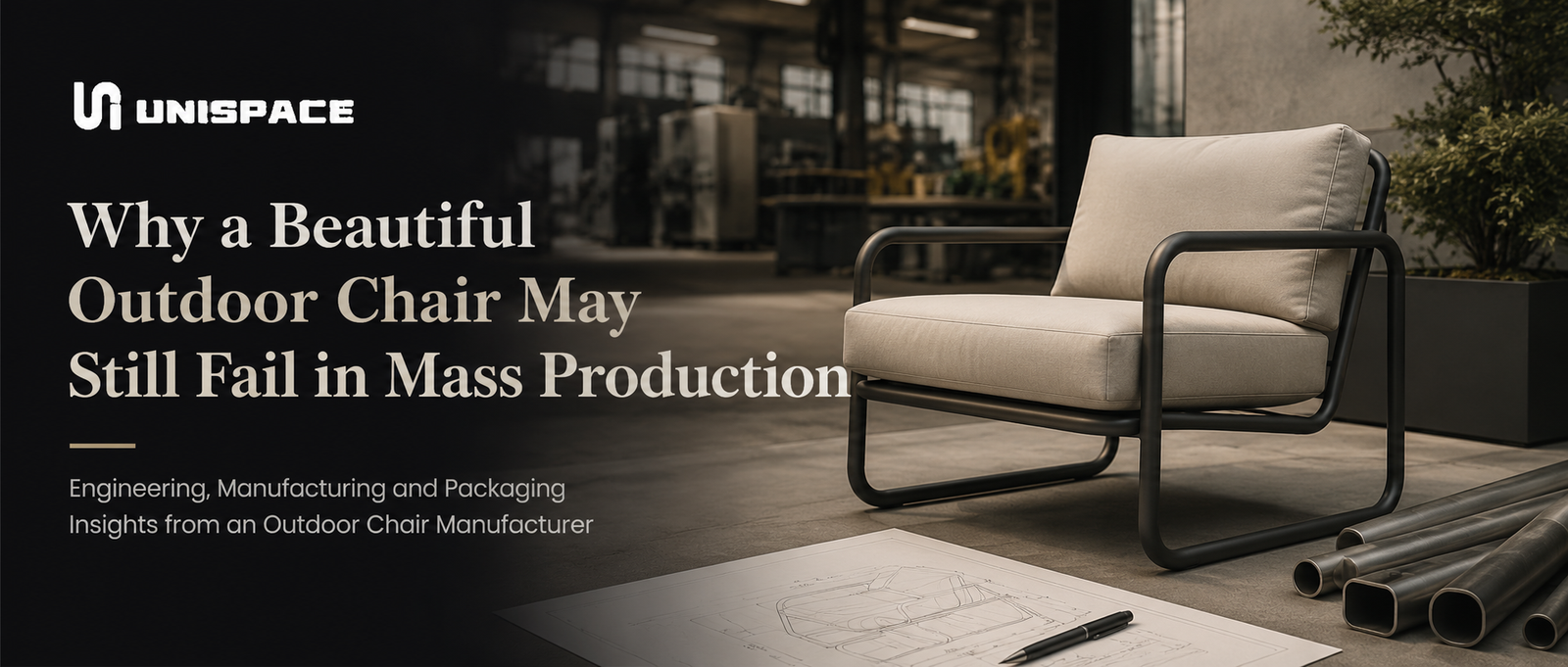
Industrial design usually begins with proportion, silhouette, comfort and visual identity. Manufacturing begins with a different question: can the same result be repeated with controlled dimensions, quality and cost?
A prototype proves that one chair can be made. A production-ready design proves that the same chair can be manufactured consistently at scale.
Before a design is frozen, a manufacturer typically reviews:
- Can the tube actually be bent to the intended geometry?
- Are welding positions accessible and controllable?
- Will tolerances accumulate during assembly?
- Is the chair stable with the real cushion and seating position?
- How many fixtures, dies and manual correction steps are required?
- Can the product be packed and loaded efficiently for export?
This distinction is especially important for custom metal outdoor furniture, where a small change in a curve, joint or connection can influence bending, welding, coating, assembly and freight cost at the same time.
2. Bend Radius & Tube Geometry
Curved metal frames are widely used in modern metal outdoor chairs because continuous tubes can create a cleaner silhouette and reduce visible fasteners. But not every curve shown in a rendering is equally practical to manufacture.
The relationship between tube diameter, wall thickness, center-line radius, straight clamping length and bend sequence directly affects formability and tooling.
For many conventional tube-bending applications, a bend radius around two times the tube outside diameter can be used as a practical early-stage reference. Tighter bends may still be achievable, but they can require mandrels, more specialized tooling and tighter process control to manage flattening, wrinkling and wall thinning.
| Design Factor | Possible Production Risk |
|---|---|
| Very small bend radius | Flattening, wrinkling and higher tooling demand |
| Multiple radii on one part | More dies, setup changes and process variation |
| Multi-plane bending | Harder positioning and dimensional control |
| Short distance between bends | Difficult clamping and possible tool interference |
| Thin wall + tight curve | Higher deformation and scrap risk |
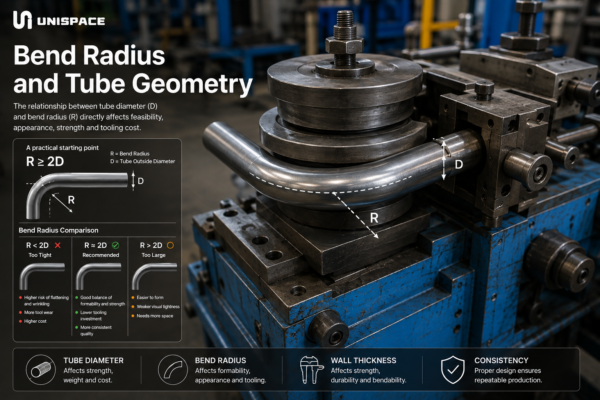
Technical note: The “2D” relationship is a practical design reference, not a universal specification. Final bend feasibility depends on material, wall thickness, tooling, machine capability and product geometry.
3. Weld Points & Tolerance Accumulation
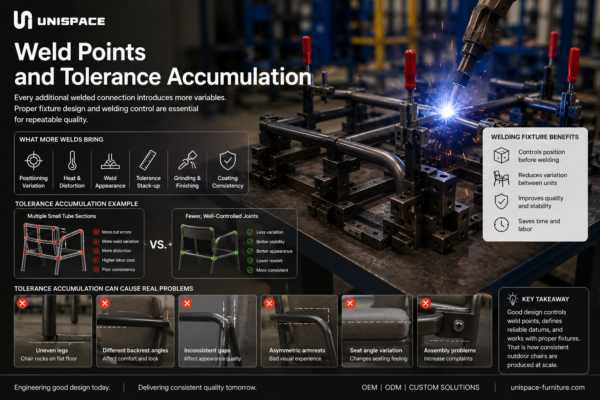
A rendering can hide welds easily. A production line cannot. Every additional welded connection introduces positioning variation, welding heat, distortion, weld appearance requirements, grinding work and another dimensional interface that must be controlled.
If a frame is divided into many small tube sections to create several angle changes, each cut length, bend angle and welding position can vary slightly. These small differences accumulate. The final chair may develop uneven legs, asymmetric armrests, inconsistent gaps, different seat angles or assembly problems.
An experienced outdoor chair manufacturer therefore evaluates the complete frame as a tolerance system rather than as a collection of independent tubes.
4. Stability & Structural Performance
Some chairs look visually balanced but behave differently once a person sits down. Center of gravity, front-to-rear footprint, seat height, backrest angle, armrest loading and cushion thickness all influence stability and structural performance.
A deep lounge chair with a highly reclined backrest, for example, may require a different rear-leg geometry from a conventional dining chair. A thicker cushion can also raise the effective seating position and change load distribution.
For B2B development, structural and stability review should happen during product development, not after mass production. Applicable requirements and customer-specific testing protocols should be identified before the structure is frozen.
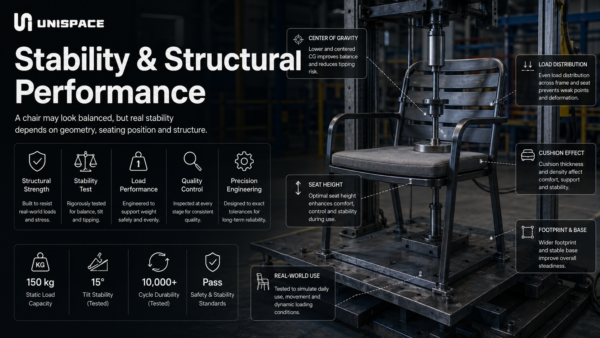
Technical note: The loads, angles and cycle counts shown in the illustration are visual examples only. Actual test methods and acceptance criteria should follow the applicable standard, buyer specification and product category.
5. Tooling & Repeatability
One of the biggest differences between prototype making and mass production is tooling. A skilled worker can sometimes build an excellent sample manually, but mass production needs fixtures and reference points that make the correct position repeatable.
Depending on the chair design, production control may include:
- bending dies and bend-sequence control;
- cutting, drilling and hole-position fixtures;
- welding jigs that define frame geometry;
- assembly fixtures and inspection gauges;
- controlled drawings, BOMs and approved samples.
A welding fixture is especially important for metal chair frames. Instead of asking an operator to position several tubes by eye, the fixture defines where every component sits before welding. This reduces variation between units and makes quality less dependent on one individual operator.
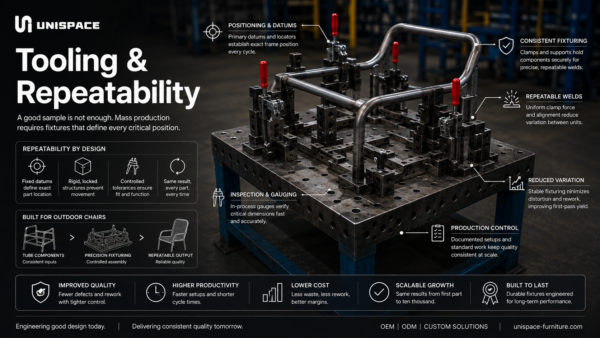
For complex outdoor furniture product development, tooling should therefore be discussed before the final sample is approved—not after the purchase order is placed.
6. Cost Engineering: Similar Steel, Different Manufacturing Logic
Material cost is only one part of the final chair cost. Two frames can use almost the same amount of steel but require very different levels of bending, welding, tooling, grinding, setup time and rework.
Imagine Chair A using three standard bends, four controlled welds and one fixture. Chair B uses eight bends, several radii, ten welds, extensive grinding and additional manual alignment. Their steel weight may be similar, but their commercial economics are not.
For an outdoor chair manufacturer, a more useful cost model is:
Material + Processing + Tooling + Labor + Scrap/Rework + Finishing + Packaging + Logistics
Discussing the target price before development helps the engineering team protect the visual features that matter while simplifying complexity that customers will never notice.
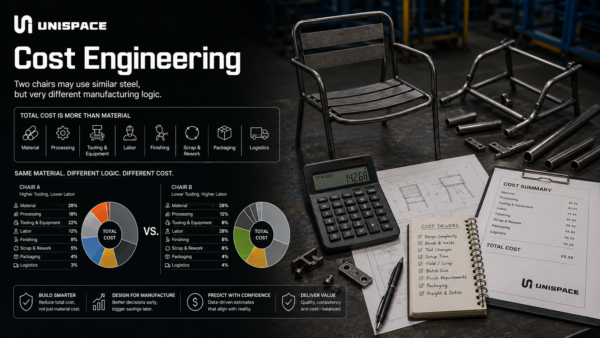
Technical note: The percentage splits shown in the illustration are examples only. Actual cost structure varies by product design, material, batch size, tooling, process route, packaging and destination.
7. Packaging & Container Efficiency
Packaging is part of product design, not an afterthought. A chair can be structurally excellent and still be commercially inefficient if wide armrests, rear-leg geometry or decorative projections create oversized cartons or poor nesting.
Before the final structure is frozen, manufacturers should evaluate:
- assembled versus knock-down (KD) construction;
- stacking and nesting geometry;
- carton dimensions and protection zones;
- surface-to-surface contact during transport;
- hardware placement and assembly experience;
- container utilization and landed cost per unit.
A KD structure can reduce volume, but it introduces another engineering question: can the connector preserve stability, appearance and assembly consistency? There is no universal answer. The best structure depends on target price, sales channel, installation expectations and freight model.
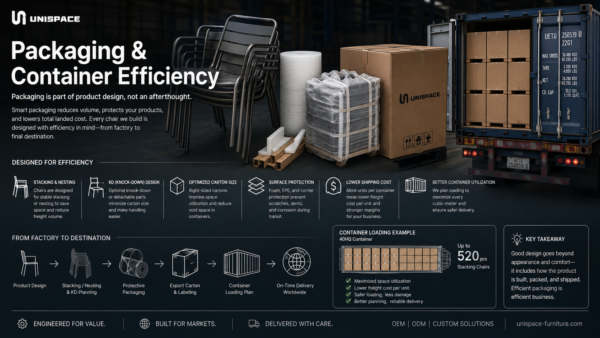
Technical note: The loading quantity shown in the illustration is an example only. Actual units per 40HQ depend on chair dimensions, nesting ratio, carton design and loading plan.
8. Design for Manufacturing: Preserve the Look, Change the Logic
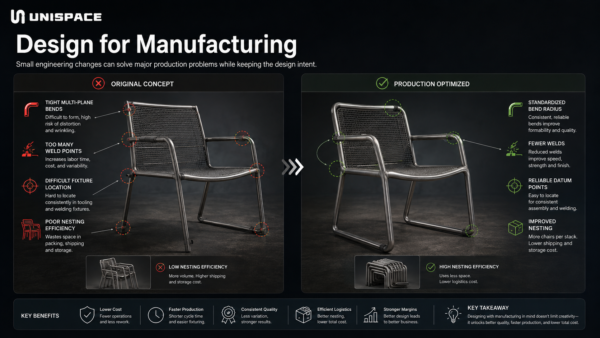
Consider a concept with a clean continuous round-tube frame. In the rendering, one tube appears to flow from the rear leg through the armrest into the backrest. Visually, it is strong. From a production perspective, the original concept may contain multi-plane bends, two tight radii close together, limited clamping length, a visible final joint and poor nesting efficiency.
The solution is not necessarily to reject the design. The engineering team can preserve the silhouette while changing the manufacturing logic.
- Standardize major bend radii where possible.
- Split one extremely complex bent component into two controllable components when it improves repeatability.
- Move welds to structurally appropriate but less visually sensitive locations.
- Create reliable datums for welding and inspection fixtures.
- Adjust the footprint slightly when stability requires it.
- Review nesting or KD opportunities before the BOM is frozen.
To the buyer, the optimized chair may look almost identical to the original rendering. To the factory, it has become a completely different product. That is industrialization.
9. B2B Buyer Checklist & Final Recommendation
Before approving a custom outdoor chair for mass production, buyers should review the product as a complete industrial system—not only as a showroom sample.
| Area | What to Confirm |
|---|---|
| Tube Geometry | Are diameter, wall thickness and bend radii practical for the structure? |
| Welding | Are unnecessary welds minimized and are critical joints controlled? |
| Fixtures | Are important dimensions controlled by jigs, gauges or defined datums? |
| Stability | Has the chair been evaluated with the actual cushion and seating position? |
| Standards | Are applicable structural and safety requirements identified before production? |
| Finish | Can welds, edges, drainage and coating coverage remain consistent in production? |
| Packaging | Has carton size, surface protection, KD or nesting efficiency been reviewed? |
| Production Data | Is the approved sample converted into drawings, BOM, standards and inspection criteria? |
For repeat orders, one question is particularly valuable:
If we reorder this design next year, what controls guarantee that the new production will match the original order?
A credible answer should involve drawings, tooling, BOM control, color standards, approved samples and inspection records—not only the memory of the first production team.
Final Recommendation
A beautiful chair is only the beginning of a successful product. For B2B buyers, the strongest design balances visual identity with structural performance, repeatable manufacturing, cost control and logistics.
That is why an experienced OEM outdoor furniture manufacturer should become involved before the design is completely frozen.
The real question is not:
“Can this chair be made?”
It is:
“Can this chair be made well, consistently and commercially at scale?”
Developing a New Outdoor Chair Collection?
Share your concept, target market and order requirements. UNISPACE can review manufacturability before mass production and help optimize structure, tooling, cost and packaging for scalable production.