


Weather-Resistant Outdoor Furniture: 8 Problems to Avoid

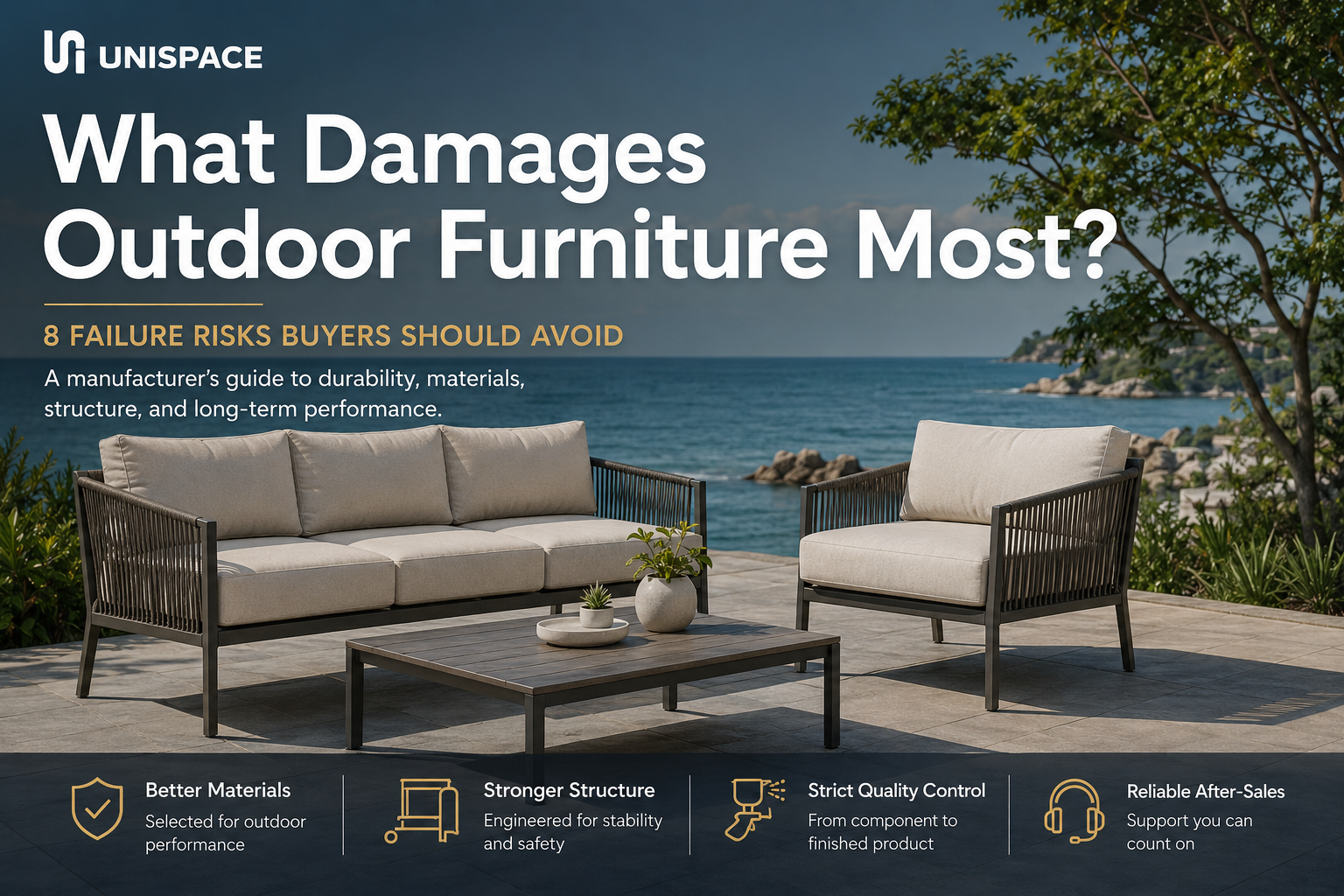
Outdoor furniture is expected to survive conditions that indoor furniture rarely faces: direct sunlight, rain, humidity, temperature changes, repeated use, dirt, chemicals, and sometimes salt exposure. Truly weather resistant outdoor furniture therefore depends on much more than choosing a material labeled “outdoor.” Long-term performance comes from matching materials, structure, finishes, fabrics, drainage, manufacturing processes, and maintenance to the real environment.
For importers, wholesalers, furniture brands, and hospitality buyers, the biggest risk is not simply that a chair eventually looks old. It is discovering premature fading, corrosion, loose frames, cracked components, or damaged cushions after hundreds of units have already reached the market. The right question is not only “Will this product survive outdoors?” but “Which part is most likely to fail first, and how was that risk controlled before mass production?”
Quick Contents
- UV Exposure and Color Fading
- Corrosion and Trapped Water
- Structural Loosening and Breakage
- Fabric, Rope, and Cushion Deterioration
- Wood Warping and Cracking
- Plastic Aging and Deformation
- Wrong Material and Process Selection
- Poor QC, Packaging, Supply Chain, and After-Sales Planning
- B2B Outdoor Furniture Risk Checklist
- Final Recommendation
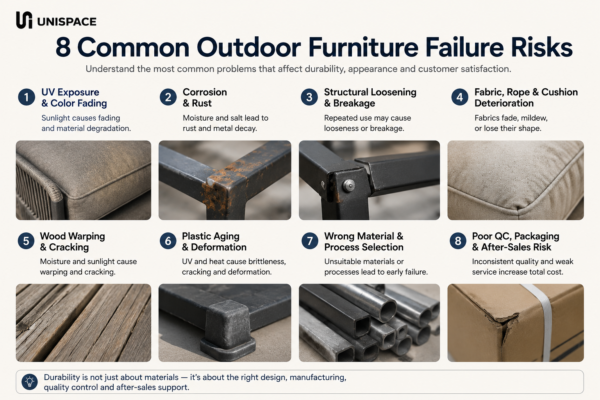
01. UV Exposure and Color Fading
Sunlight is one of the most underestimated enemies of outdoor furniture. Frames, fabrics, rope, wicker, plastic parts, and cushions can all change after prolonged exposure. The visible result may begin with color fading, but UV exposure can also accelerate the aging of textile fibers, polymers, and some surface finishes.
For B2B procurement, “UV resistant” should not remain a vague marketing claim. Buyers should confirm the fabric or rope specification, test method where required, acceptable color change, batch-to-batch consistency, and suitability for the target climate. A product that looks perfect in a showroom may perform very differently on an exposed hotel terrace in California, Australia, or a coastal market.
Weather resistance should therefore be designed around the final use environment, not only the sample-room appearance. Approved fabric codes and color standards should also remain traceable for repeat orders and replacement parts.
02. Corrosion and Trapped Water
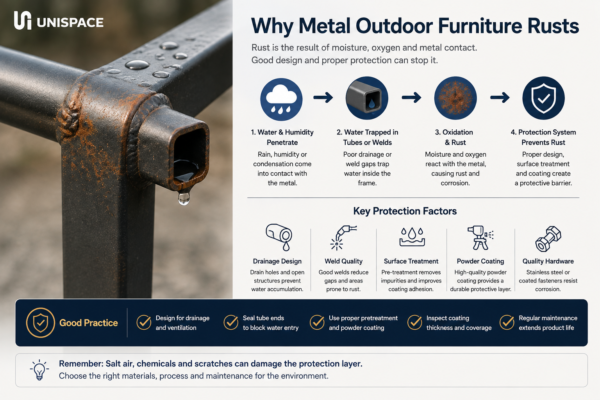
For metal outdoor furniture, corrosion is one of the most important performance risks. Steel offers strength, stability, manufacturability, and cost efficiency, but its corrosion resistance depends on the complete protection system: substrate condition, pretreatment, weld quality, drainage, coating coverage, fasteners, and handling after coating.
One detail is especially easy to overlook: water management. Low points, enclosed tubes, and poorly drained sections can retain rainwater or condensation. Over time, trapped moisture increases corrosion risk from the inside, where the problem may not be visible during a normal final inspection.
Powder coating is important, but it cannot compensate for weak pretreatment or poor drainage. A typical commercial outdoor project may specify a cured powder film around 60–100 μm, but the correct target depends on the substrate, coating system, geometry, environment, and acceptance criteria. Salt-spray testing such as ASTM B117 can be useful for comparing systems, but test hours should not be treated as a direct prediction of years in service.
03. Structural Loosening and Breakage
A chair that looks strong is not necessarily structurally reliable. Outdoor furniture is repeatedly loaded, dragged, stacked, moved, and leaned on. Commercial applications create even greater stress on welds, connectors, legs, and moving mechanisms.
Typical failures include loose chair legs, cracked welds, deformed frames, loose screws, unstable tables, and fatigue failure in reclining or swivel mechanisms. Tube wall thickness is only one variable. In many steel outdoor furniture programs, 0.8–1.5 mm can be a useful engineering reference range, but load path, tube diameter, geometry, reinforcement, and welding design matter just as much.
Structural safety and comfort should also be validated together. For many outdoor seating categories, a seat height around 400–460 mm is a common reference, although the correct dimension depends on product type and market. A good sample proves that one product can be made; a controlled engineering and production system proves that hundreds or thousands can be made consistently.
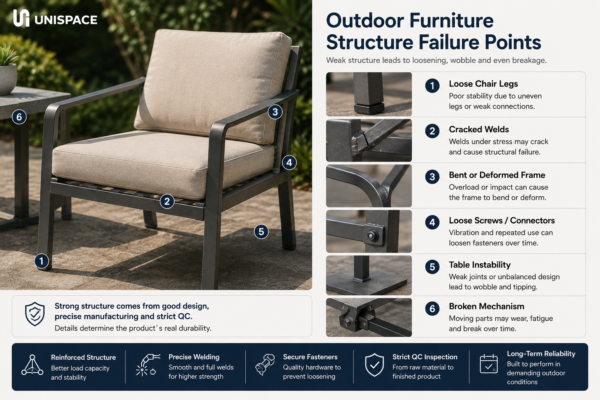
| Typical Failure | Possible Manufacturing / Design Cause |
|---|---|
| Loose chair legs | Weak connection design or inconsistent assembly |
| Frame deformation | Insufficient support, unsuitable tube specification, or overload |
| Cracked weld | Poor weld penetration or stress concentration |
| Loose screws | Connector design, vibration, or assembly inconsistency |
| Table instability | Geometry or tolerance-control problem |
| Broken mechanism | Component fatigue or insufficient durability testing |
04. Fabric, Rope, and Cushion Deterioration
Soft materials often determine how quickly consumers perceive outdoor furniture as “old.” Faded covers, mildew, collapsed foam, loose seams, stretched rope, brittle wicker, and water trapped inside cushions can all generate complaints even when the metal frame remains structurally sound.
Water resistance and weather resistance are not the same. A cushion should be considered as a complete system: outer fabric, seam construction, zipper, inner liner, foam, ventilation, and drainage. For many lounge and sofa programs, cushion thickness around 80–120 mm is common, but foam density, rebound, drying behavior, and intended comfort level are more important than thickness alone.
For B2B programs, replacement planning matters as well. Cushion dimensions, fabric codes, color standards, sewing patterns, rope specifications, and attachment methods should remain traceable so that damaged components can be replaced without changing the complete furniture set.
05. Wood Warping and Cracking
Wood adds warmth and natural texture to outdoor furniture, but moisture movement is unavoidable. Unsuitable species, poor drying, exposed end grain, coating failure, or repeated wet-dry cycles can contribute to checking, warping, cracking, mold, and dimensional change.
Buyers should therefore review wood species, moisture control, joint design, surface treatment, drainage, and maintenance requirements. Sustainability can also be integrated at the material-selection stage through traceable timber, recyclable metals, repairable components, and product designs that extend useful service life.
06. Plastic Aging and Deformation
Plastic components are often assumed to be maintenance-free, but UV exposure, heat, repeated loading, and resin formulation all influence performance. The visible result may be discoloration, brittleness, cracking, surface chalking, or deformation.
Small plastic parts deserve particular attention. A metal chair may have an excellent frame but still create complaints if foot glides, end caps, connectors, or adjustment components fail prematurely. Resin type, UV stabilizers, pigmentation, geometry, and service temperature should be evaluated together.
07. Wrong Material and Process Selection
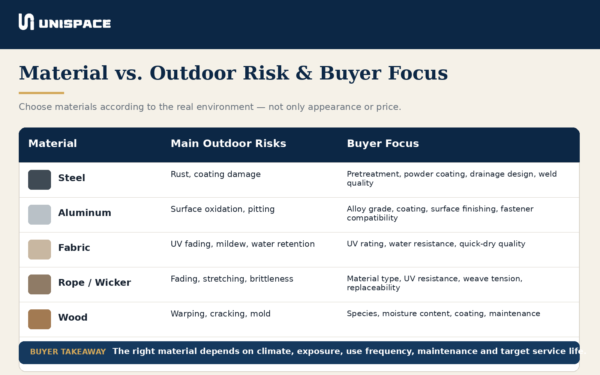
Many outdoor furniture failures begin before production. They begin when the product specification does not match the use environment. A residential balcony, coastal resort, rooftop restaurant, poolside deck, and covered garden are all “outdoor,” but their corrosion, UV, structural, cleaning, and maintenance requirements can be very different.
An experienced outdoor furniture supplier should do more than quote from a reference photo. Frame material, tube specification, welding method, coating system, fabric, foam, rope, hardware, tabletops, connectors, packaging, and test requirements should be developed as one product system.
| Environment | Key Risk | Buyer Priority |
|---|---|---|
| Coastal terrace | Salt and humidity | Corrosion resistance |
| Poolside | Water and chemicals | Coating, fabric, and fastener performance |
| Rooftop restaurant | Wind and heavy use | Stability and structural strength |
| Residential patio | Weather + maintenance | Balanced cost and durability |
| Hotel / resort | High-frequency use | Structural reliability and replacement planning |
| Covered garden | Lower direct exposure | Comfort, aesthetics, and value |
08. Poor QC, Packaging, Supply Chain, and After-Sales Planning
For wholesalers, importers, retailers, and project buyers, product durability is only part of the risk. The commercial result also depends on batch consistency, packaging protection, loading efficiency, supply continuity, replacement compatibility, and after-sales response.
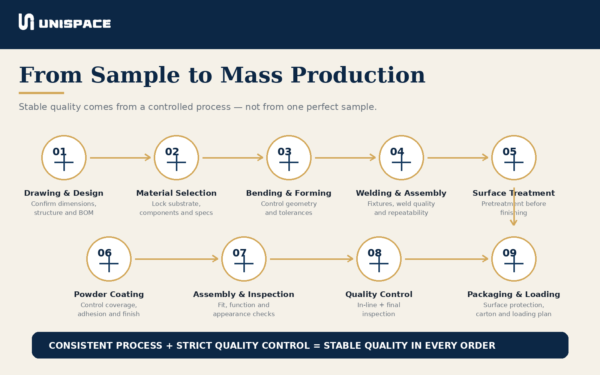
The approved sample should be translated into controlled production data: engineering drawings, BOM, color standards, welding fixtures, bending jigs, signed samples, and inspection criteria. Packaging should also be developed with the product. Surface protection, carton strength, hardware placement, KD structure, assembly experience, and container utilization all affect total cost and claim risk.
Supply-chain planning should identify critical components early so that one delayed fabric, mechanism, or hardware part does not stop the entire production schedule. Before shipment, buyers should also clarify spare parts, traceability, warranty boundaries, claim procedures, and technical support.
09. B2B Outdoor Furniture Risk Checklist
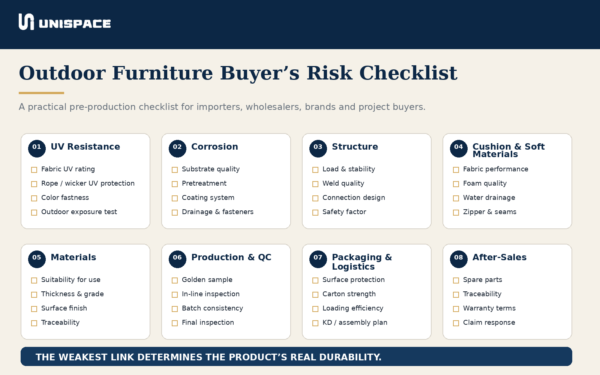
Before confirming mass production, buyers can review the product across eight areas. The important point is that weather resistance is a system, not a single material feature. One weak detail can determine the real durability of the complete product.
| Area | What to Check |
|---|---|
| UV resistance | Fabric, rope, wicker, plastics, and coating specifications |
| Corrosion | Substrate, pretreatment, coating, drainage, welds, and fasteners |
| Structure | Load path, welds, connectors, stability, and testing |
| Cushions | Fabric, foam, drainage, zipper, seams, and replacement |
| Materials | Suitability, grade, thickness, surface finish, and traceability |
| Production | Drawing, BOM, golden sample, in-line inspection, and batch consistency |
| Packaging | Surface protection, carton structure, KD plan, and container loading |
| After-sales | Spare parts, traceability, warranty terms, and claim responsibility |
10. Final Recommendation: Outdoor Furniture Fails at Its Weakest Detail
The biggest threat to outdoor furniture is rarely just rain, sunlight, or rust. It is the interaction of environment, material, structure, manufacturing, and maintenance. A premium fabric cannot compensate for a weak frame. A thick steel tube cannot compensate for poor corrosion protection. An attractive powder-coated finish cannot compensate for trapped water. And a durable product can still become an expensive B2B problem if packaging, replacement parts, and after-sales responsibilities were never planned.
From a manufacturer’s perspective, the best approach is to identify the target market and real use environment before sampling begins. Instead of asking only, “Is this outdoor furniture weatherproof?”, buyers should ask: “How has every material, structure, finish, and manufacturing process been designed for this specific environment?” That question leads to better specifications, more reliable production, fewer claims, and longer-lasting outdoor furniture.
Developing a new outdoor furniture collection or commercial project?
Share your target market, application environment, product type, and performance requirements with UNISPACE to evaluate the right frame, finish, fabric, structure, packaging, and quality-control solution.