


2026 Metal Furniture Industry Trends


2026 Metal Furniture Industry Trends: What Buyers and Brands Should Plan for Now
In 2026, metal furniture industry trends are being reshaped by three forces happening at the same time: continued demand growth (especially in outdoor living), greater pressure on cost and lead-time predictability, and a clear shift toward compliance and traceable documentation. For brands, importers, retailers, and project buyers, the competitive edge is no longer just a good-looking product. It is a repeatable delivery system—engineering-ready designs, stable batch consistency, durable finishing, and packaging that reduces damage and claims.
Market outlook: growth continues, but demand becomes more segmented
Multiple market studies indicate that both metal and outdoor categories remain on a growth track, while the buying logic becomes more specialized by channel and use case.
- Global metal furniture market: projected to grow from USD 97.02B (2025) to USD 158.75B (2032), forecast CAGR 7.29%.
- Global outdoor furniture market: estimated at USD 50.89B (2024), projected to reach USD 86.65B by 2033, CAGR 6.3% (2025–2033).
- U.S. furniture market: estimated at USD 172.33B (2024), expected CAGR 6.2% (2025–2033).
Practical meaning for 2026: buyers increasingly request (1) retail-ready SKUs, (2) quick-ship programs, (3) project-grade durability, and (4) consistent appearance across repeated replenishment orders.

Design direction: outdoor living, modular sets, and ‘indoor-grade’ comfort
1) Outdoor spaces keep moving toward ‘indoor comfort’
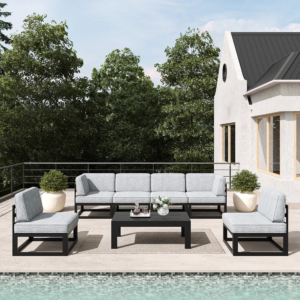
Outdoor collections continue to look and feel more like indoor living rooms: deeper seating, thicker cushions, coordinated palettes, and mixed-material styling (metal frames combined with rope, sling, wood accents, or stone-look tabletops). For suppliers, this raises requirements on frame geometry, welded joints, and long-term appearance stability—because comfort-driven designs are often larger and more demanding on structure.
2) Modular systems simplify merchandising and reduce SKU risk
Retailers and e-commerce sellers are pushing modular programs because fewer base modules can create more configurations (2-seater, 3-seater, corner section, chaise, lounge set). This improves inventory efficiency and gives customers options without expanding SKU count. For manufacturers, the key is standardizing connection points, tolerance control, and packaging solutions that protect modular components during shipping.
3) Texture-driven finishes and neutral palettes stay strong
Matte and micro-texture finishes remain popular because they hide minor scratches, reduce fingerprint visibility, and communicate a premium look. Neutral tones (sand, stone, charcoal, warm gray) keep selling across markets and reduce dead-stock risk. The challenge is maintaining batch-to-batch color stability at scale, especially across different suppliers of powder or paint.
Manufacturing and quality: finishing performance becomes the deciding factor
For metal furniture, finishing is not cosmetic; it is structural protection. In 2026, expect higher buyer attention on measurable finishing details: edge coverage (corners and sharp radii), protection at weld zones, adhesion consistency, gloss/texture stability, and corrosion resistance in humid or coastal environments.
A growing number of buyers will request clear finishing specifications and inspection checkpoints because field failures usually show up first at edges, welded joints, and contact points.

What ‘batch consistency’ means in 2026
Batch consistency is measurable control across three layers:
1) Dimensional repeatability (fixtures, forming accuracy)
2) Weld stability and clean finishing (uniform grinding standard)
3) Surface finishing repeatability (pretreatment, coating application, curing control)
When these layers are managed as a system, suppliers can reduce rework, minimize claims, and deliver reliable replenishment programs.
Cost and lead time: from ‘lowest quote’ to ‘predictable total landed cost’
In 2026, price competitiveness still matters, but it is increasingly evaluated as total landed cost: unit price plus defect risk, damage rate, lead-time variability, and after-sales friction. This is especially true for e-commerce and project buyers, where late deliveries or damage claims can eliminate margin quickly.
Steel and aluminum volatility and policy shifts can affect cost structures. For buyers, this reinforces a key sourcing rule: prefer suppliers with standardized processes, clear capacity planning, and disciplined packaging, because these reduce hidden costs more reliably than negotiating the last 1–2% of unit price.
Compliance and documentation: carbon data enters procurement files
Compliance is becoming operational. In the EU, the Carbon Border Adjustment Mechanism (CBAM) moves into its definitive regime starting on 1 January 2026. Even when a finished furniture SKU is not directly in scope, upstream metals (iron/steel, aluminum) and documentation readiness influence customer expectations and downstream audits.
What buyers increasingly ask for in 2026:
• Material and process transparency (basic traceability)
• Clear origin and supplier documentation
• Readiness to support emissions-related reporting when required by customers or regulators

Channel trends: e-commerce and projects raise the bar on packaging and standardization
E-commerce growth increases exposure to last-mile handling, making packaging performance a key driver of reviews, returns, and brand reputation. Project buyers also demand standardization—consistent appearance across multiple shipments and reliable delivery windows. In 2026, suppliers that treat export packing as part of product engineering (corner protection, abrasion prevention, carton strength, clear markings, and loading efficiency) will reduce claims and improve repeat business.
2026 buyer checklist: how to source metal furniture with lower risk
1) Ask for a process map: cutting → bending → welding → finishing → assembly → packing
2) Confirm batch controls: color/texture master sample, tolerance targets, weld/edge finishing standard
3) Align lead-time logic: capacity plan, peak-season strategy, raw material handling
4) Lock packing early: KD vs assembled, protective materials, carton marks, drop-risk design
5) Prepare a compliance-ready file: basic traceability and documentation readiness
Summary: what will win in 2026
In 2026, metal furniture winners are those who combine modern equipment with disciplined execution: predictable lead time, cost-effective production, stable batch consistency, and customization support that converts ideas into manufacturable products. Buyers increasingly select partners who can prove their system, not just show a sample.
Data references (for citation and internal review)
- Fortune Business Insights – Metal Furniture Market (projection to 2032, CAGR 7.29%).
- Grand View Research – Outdoor Furniture Market (2024 size, 2033 projection, CAGR 6.3%).
- Grand View Research – U.S. Furniture Market (2024 size, CAGR 6.2%).
- European Commission – Carbon Border Adjustment Mechanism (CBAM definitive regime from 1 Jan 2026).