
Outdoor Couch Sofa Buying Guide: What Buyers Should Know Before Sourcing

An outdoor couch sofa is more than a comfortable seat for patios or gardens. For importers, wholesalers, furniture brands, and project buyers, it affects comfort, frame structure, weather resistance, packaging volume, container loading, and long-term customer satisfaction. This guide explains what buyers should check before sourcing outdoor couches sofas for residential or commercial use.
Quick Contents
- What Is an Outdoor Couch Sofa?
- Common Frame Materials for Outdoor Couch Sofas
- Cushion, Fabric and Weather-Resistance Considerations
- Residential vs. Commercial Outdoor Couch Sofas
- What Importers Should Check Before Sourcing
- How to Work with an Outdoor Sofa Manufacturer
- Final Recommendation
1. What Is an Outdoor Couch Sofa?
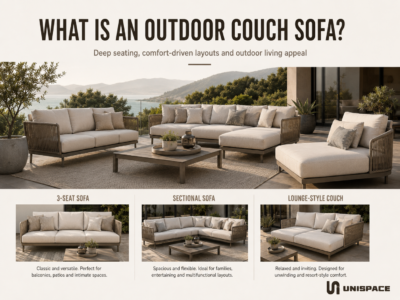
An outdoor couch sofa usually refers to a long, comfortable outdoor sofa designed for relaxed seating. Compared with a single outdoor chair, it creates a more social lounge area and is commonly used on patios, balconies, gardens, poolside decks, rooftop terraces, and hospitality spaces.
In different markets, buyers may search with different terms. Some American customers use outdoor couch sofa or outdoor couch. Others search for outdoor patio sofa, patio couch, garden sofa, or outdoor sofas. For SEO and product planning, these terms should be understood as related search intent, not completely different product categories.
| Search term | Buyer intent | Content use |
|---|---|---|
| outdoor couch sofa | Comfortable lounge sofa for outdoor living | Primary entry keyword |
| outdoor patio sofa | Sofa for patio, garden, balcony, or poolside spaces | Related product/category intent |
| outdoor sofas | Broad product category search | Category page and internal link support |
| outdoor couches sofas | Plural/variant search expression | Long-tail supporting keyword |
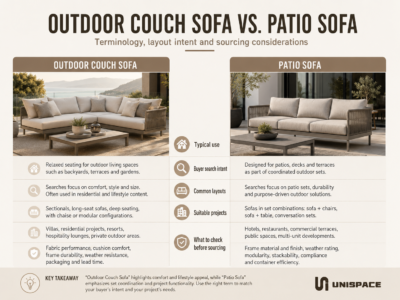
From a sourcing perspective, the important question is not only the name. Buyers need to confirm whether the product is designed for real outdoor use: weather-resistant frame, suitable cushion structure, outdoor fabric, stable feet, safe packaging, and repeatable mass production.
For website planning, this topic can work as an entry article. The product category page can target broader outdoor sofas, while this guide captures buyers who use more conversational search terms such as outdoor couch sofa, outdoor patio sofa, and outdoor couches sofas.
2. Common Frame Materials for Outdoor Couch Sofas
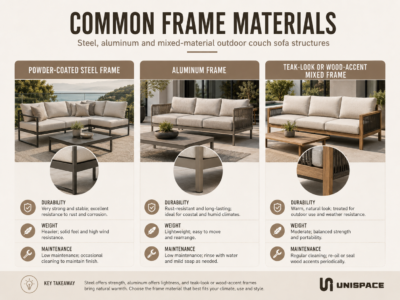
The frame decides the structure and long-term stability of an outdoor couch sofa. Common frame options include powder-coated steel, aluminum, PE wicker over a metal frame, outdoor rope with a metal frame, and wood or wood-look accents combined with metal support.
Powder-coated steel is often selected when buyers need strong structure, cost control, and repeatable production. For steel products, the key is the complete protection system: tube specification, welding quality, grinding, pretreatment, outdoor-grade powder coating, drainage holes, glides, and hardware. A common outdoor powder coating thickness is around 60-100 microns, depending on the coating system and product geometry.
| Frame option | Main advantage | Buyer should check |
|---|---|---|
| Powder-coated steel | Strong, stable, cost-effective | Tube thickness, welding, coating, drainage |
| Aluminum | Lightweight, red-rust resistant | Reinforcement, wall thickness, stability |
| PE wicker over metal frame | Relaxed woven look | UV grade, weaving tension, hidden frame |
| Outdoor rope with metal frame | Modern and soft appearance | Rope tension, contact points, frame strength |
Aluminum is lighter and naturally resistant to red rust, which makes it useful for coastal residential collections or products that need easier handling. However, because aluminum is less rigid than steel, it often requires suitable tube size and reinforced structure to achieve the right stability.
For mass production, frame material should also match welding fixtures, bending accuracy, coating capacity, and packing method. Common steel tube wall thickness may range from 0.8-1.5 mm for many outdoor sofa programs, but the final specification should depend on design, load requirement, target price, and market positioning.
3. Cushion, Fabric and Weather-Resistance Considerations
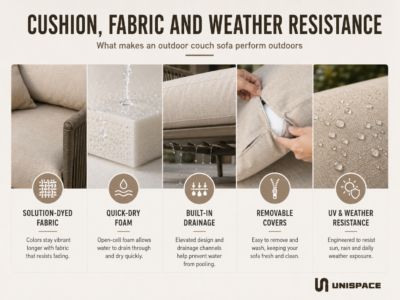
Cushions and fabric strongly affect the comfort and perceived value of outdoor couches sofas. A common lounge cushion thickness ranges from 80-120 mm. Softer cushions create a relaxed feeling, while firmer cushions may perform better in commercial spaces with frequent use.
For outdoor use, buyers should check UV resistance, water repellency, color fastness, seam quality, zipper quality, and whether cushion covers are removable. In humid climates or poolside projects, quick-dry foam or reticulated foam can be considered, but it usually increases cost and should match the target market position.
Weather resistance is not created by one material alone. It comes from the full product system: frame protection, drainage design, cushion construction, fabric quality, feet, fasteners, and packaging protection during export shipping.
Buyers should also define the expected maintenance level. A removable cushion cover may reduce cleaning problems, but only if the zipper, stitching, and fabric shrinkage are properly controlled. For commercial projects, fabric color and foam recovery should be tested more carefully because daily use is much heavier than in a private garden.
4. Residential vs. Commercial Outdoor Couch Sofas
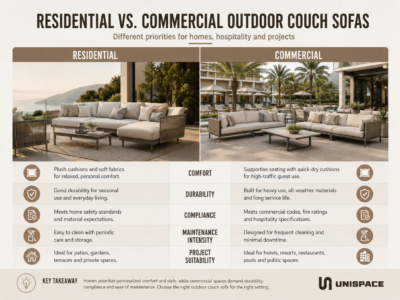
Residential and commercial outdoor sofas may look similar in photos, but buyers should evaluate them differently. Residential customers usually care more about appearance, comfort, cushion softness, color matching, and how the sofa fits a private patio or garden.
Commercial buyers care more about high-frequency use, cleaning, replacement parts, warranty risk, and stable repeat orders. Hotels, restaurants, cafés, rooftop bars, and rental projects require stronger frames, easier maintenance, and clearer spare-part management.
Typical seat height for outdoor sofas is around 400-460 mm, while seat depth often ranges from 520-620 mm. For relaxed residential lounging, deeper seats may be attractive. For cafés or public terraces, a more upright sitting angle and easier cleaning may be more practical.
This difference is important for product line planning. A lifestyle collection may use softer cushions and warmer colors, while a commercial outdoor patio sofa program may require stronger frames, darker fabrics, replaceable glides, and more standardized spare parts.
5. What Importers Should Check Before Sourcing
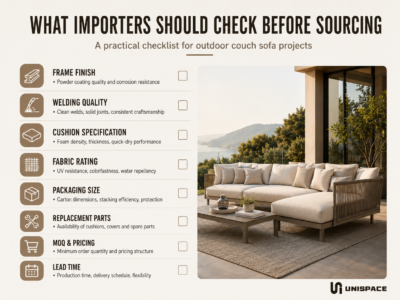
Before sourcing an outdoor couch sofa, importers should not only compare unit price. A lower price may look attractive, but hidden costs can appear in packaging volume, shipping damage, assembly complaints, fabric fading, coating failure, or difficult after-sales replacement.
Important sourcing checks include product dimensions, carton dimensions, CBM per set, net and gross weight, estimated 40HQ loading quantity, cushion packing method, assembly structure, and whether product photos match the real sample. If the sofa is part of a collection, buyers should also confirm color consistency and module compatibility for repeat orders.
| Checkpoint | Why it matters |
|---|---|
| Product dimensions | Affects comfort, placement, and carton size |
| Carton dimensions and CBM | Affects freight cost and container loading |
| Frame and coating details | Affects outdoor durability and warranty risk |
| Cushion and fabric specification | Affects comfort, drainage, and colorfastness |
| Assembly and spare parts | Affects end-user experience and after-sales service |
For outdoor patio sofa programs, packaging should be discussed early. Oversized cartons can reduce container loading efficiency, while overly compact packaging may increase compression marks or assembly difficulty. A practical solution should balance protection, loading quantity, and end-user assembly experience.
Importers should also request pre-shipment photos or inspection records for key details: carton marks, spare parts bags, cushion packing, coating surface, module labels, and loading sequence. These small controls help reduce disputes after the container arrives.
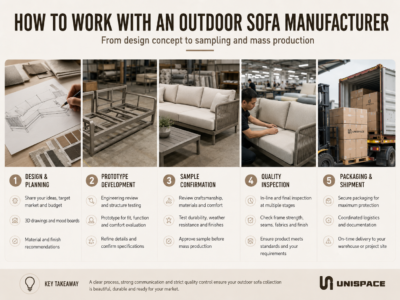
6. How to Work with an Outdoor Sofa Manufacturer
Working with an outdoor sofa manufacturer should be more than asking for a quotation. A professional supplier should help buyers evaluate product structure, material selection, target market, packing method, and customization feasibility before sampling.
For OEM and ODM projects, buyers should share the target market, expected retail price level, usage scenario, material preference, order quantity, packaging requirements, and compliance expectations. The manufacturer can then suggest suitable tube sizes, frame structure, cushion thickness, coating system, and packing design.
The best sourcing results usually come from clear communication before sampling. Drawings, sample comments, material swatches, packing data, and loading estimates help both sides reduce mistakes before mass production.
For long-term cooperation, the manufacturer should keep stable product records, including drawings, color codes, fabric references, coating requirements, packing photos, and QC standards. This makes future repeat orders easier and helps buyers build a more reliable outdoor sofa collection.
Final Recommendation
An outdoor couch sofa is a useful entry product for buyers who want to cover outdoor sofas, outdoor patio sofa searches, and related lifestyle furniture demand. However, sourcing decisions should go beyond appearance and keyword popularity.
For B2B buyers, the better choice is the product that matches the target market, climate, frame structure, cushion system, packaging plan, and long-term supply strategy. A reliable manufacturer should help turn a good-looking sofa into a product that can be produced, shipped, assembled, and reordered smoothly.