


How to Choose a Practical Tall Drawer Cabinet for Small Spaces

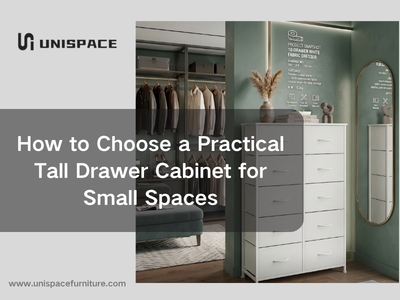

From a manufacturer’s perspective, a practical tall drawer cabinet should not only fit a limited footprint. It should also make efficient use of vertical space, remain stable during everyday use, and be planned with transport and assembly in mind.

Why do tall narrow cabinets work well in small spaces?
One reason tall storage cabinets remain popular is that they use vertical space more efficiently than wider, lower storage units. In small rooms, floor area is often the most limited resource. A narrow cabinet footprint makes placement easier and helps keep the room visually lighter.
At the same time, multiple drawers make it easier to sort clothing, accessories, household items, and everyday essentials. Compared with open shelves, drawer-based storage usually looks cleaner and reduces visual clutter.
A tall drawer cabinet is therefore more than a small cabinet with many drawers. It is a space-efficient storage solution designed for compact living.
What materials really matter in a tall drawer cabinet?

When evaluating this kind of cabinet, materials should not be treated as isolated specifications. What matters more is how they work together.
For example, 12mm laminated particle board is commonly used in indoor storage furniture because it provides a flat surface, a consistent appearance, and practical everyday usability. The laminated finish also makes cleaning easier than unfinished board.
A 0.6mm metal square tube frame adds structural support. In a tall cabinet, vertical stability matters a great deal. A properly designed frame helps the cabinet feel more secure, especially when multiple drawers are stacked in one vertical unit.
The powder-coated finish is also worth noting. It is not simply decorative. It helps improve surface consistency and supports better wear resistance in everyday handling.
Why are steel-and-wood cabinets with fabric drawers so common?

Steel-and-wood storage furniture has become more common because it balances structure, visual lightness, and transport efficiency.
Compared with fully fabric drawer units, a steel-and-wood cabinet usually offers a stronger frame and a more defined overall form. Compared with heavy all-wood cabinets, it is often easier to package, easier to move, and more suitable for knock-down construction.
The drawers in this category often use a mixed construction. For example, a 3mm E1 MDF front panel gives the drawer a cleaner visual face, while the non-woven fabric drawer body helps reduce weight and improve handling convenience.
This kind of drawer is not intended to replace heavy-duty wooden drawers in every category. It is better understood as a practical solution for light daily storage, where ease of use, weight control, and flexible organization are more important than heavy load-bearing performance.
Why does knock-down design matter more than many buyers expect?

Knock-down design is often discussed in relation to packaging, but its role is broader than just saving box space.
For modern furniture supply, especially in e-commerce, export shipping, and retail distribution, knock-down construction improves carton efficiency and reduces wasted shipping volume. It also makes warehousing and last-mile delivery easier to manage.
For buyers, this means a cabinet can be delivered in a compact carton while still being assembled with standard hardware, installation tools, and a user manual. For suppliers, it means better loading efficiency and more flexible shipping arrangements.
In other words, knock-down design is part of how a product is prepared for real-world logistics.
What should buyers check before choosing this kind of cabinet?
For this kind of product, appearance and drawer count are only the starting point. Buyers should also ask whether the frame is stable enough for a tall structure, whether the materials match the intended use, whether the finish is consistent, and whether the packaging is good enough for transport and delivery.
It is also useful to consider whether the knock-down structure is efficient without making assembly unnecessarily complicated. A product can save space in shipping, but it still needs to be practical for the end user after delivery.
In many cases, the most useful question is not “How many drawers does it have?” but “How well are all the details integrated into one practical product?”
A practical example: a 10-drawer 5-tier tall cabinet
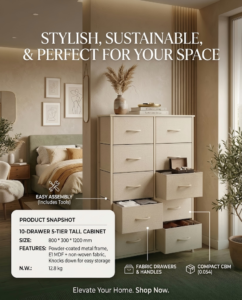
A useful example is a 10-Drawer 5-Tier Tall Cabinet designed in knock-down structure for compact indoor storage.
Its product size is 800 × 300 × 1200 mm, which allows it to fit relatively narrow spaces while still offering substantial vertical storage. This makes it suitable for bedrooms, entryways, apartments, and similar spaces where floor area is limited.
The cabinet combines 12mm laminated particle board, 0.6mm metal square tube, and powder-coated metal parts. The drawers use 3mm E1 MDF fronts, non-woven fabric bodies, and PP fabric drawer handles.
From a packaging perspective, the package size is 1170 × 310 × 150 mm, with a volume of 0.054 CBM. The package includes bubble bag, corner protectors, and carton box, together with installation tools, screw kit, silicone desiccant, and a user manual.
These details may look technical, but together they show a practical product logic: space-saving dimensions, manageable weight, reasonable structure, and a transport-friendly knock-down format.
Final Thoughts
A practical tall drawer cabinet is not simply about putting more drawers into a narrow frame. Its real value lies in how space efficiency, material selection, drawer construction, knock-down design, and packaging are brought together in one usable product.
For small-space living, that matters a great deal. Customers are not only buying storage furniture. They are also buying organization, convenience, efficient transport, and ease of daily use.
From a manufacturer’s point of view, the best storage furniture is often not the most complicated one. It is the one that solves everyday needs in a clear and efficient way.
