


Steel vs. Aluminum Outdoor Chairs: Cost, Weight and Durability

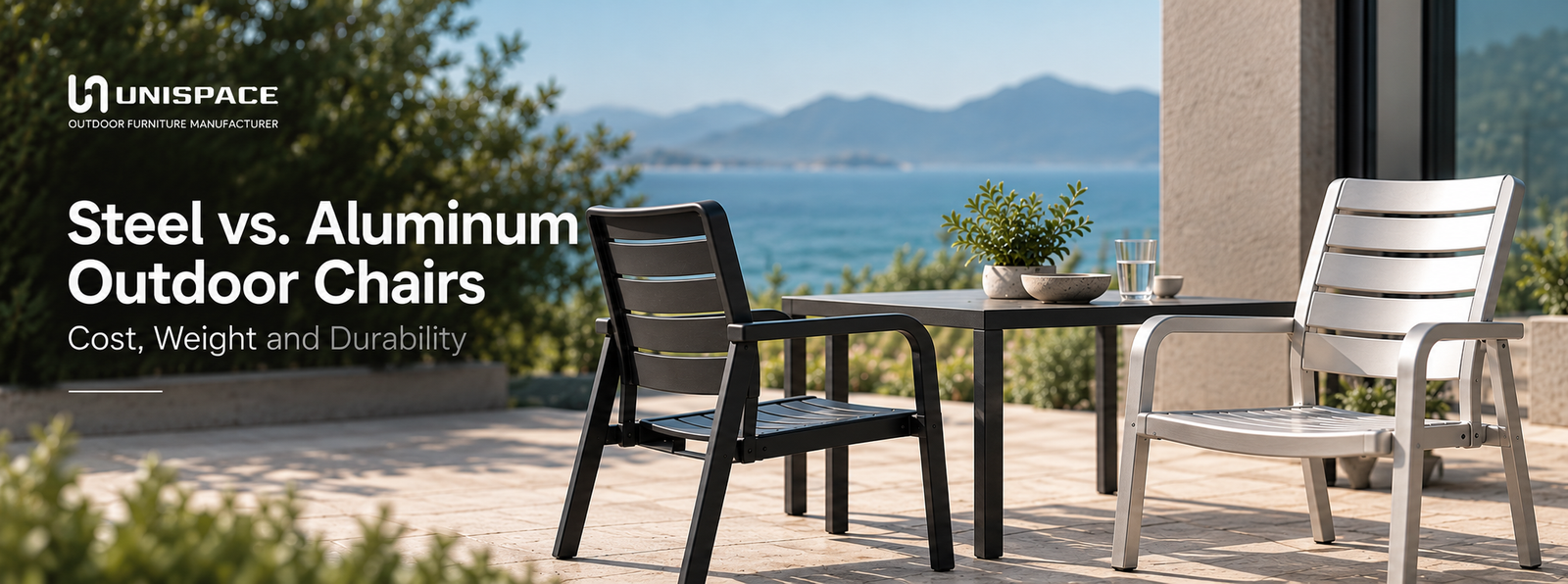
Both metals are widely used in outdoor seating, but they influence production cost, frame weight, corrosion protection, design flexibility, and shipping in different ways. A powder-coated steel chair may be well suited to a competitive retail collection, while an aluminum chair may support a lighter, easy-to-move product range.
Neither material guarantees a reliable product by itself. Frame geometry, welding, surface finishing, quality control, and expected use conditions all matter.
The more useful question is which frame material delivers the right balance of performance, landed cost, and product positioning.
This manufacturing-focused guide examines the decisions that matter when sourcing metal outdoor chairs for different markets and sales channels.
1. Purchase Cost and Manufacturing Efficiency
Steel generally has a lower raw material cost than aluminum for many conventional furniture applications. However, factory quotations should not be judged by the metal price alone.
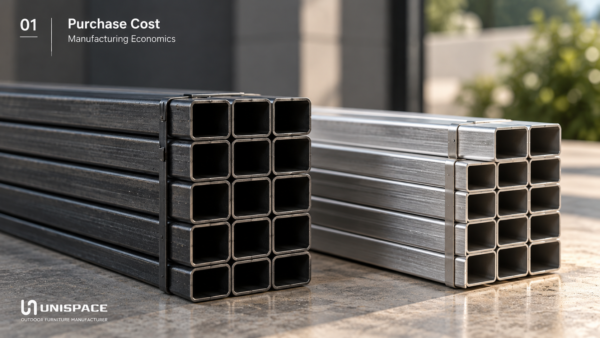
Steel and aluminum profiles used in outdoor furniture manufacturing.
A typical steel chair may involve tube cutting, bending, welding, surface preparation, powder coating, and assembly. Aluminum chairs can follow a similar process, but alloy selection, extruded profiles, fabrication methods, and welding requirements may affect the final price.
The main cost variables include:
- Material specification: Metal grade, tube diameter, wall thickness, profile shape, and material yield.
- Frame complexity: Number of bends, joints, components, and welding operations.
- Production consistency: Tooling, batch size, labor requirements, and process repeatability.
- Surface protection: Pretreatment, coating type, and any additional protective layers.
- Assembly and packing: Fully welded, stackable, or knock-down designs.
A straightforward aluminum chair may cost less to produce than a highly complex steel chair. Likewise, an optimized steel structure can provide strong value when the design is appropriate for volume manufacturing.
Buying point: Compare quotations using equivalent dimensions, performance targets, finish requirements, order volumes, and packaging specifications. Different quotations may represent very different products.
2. Weight, Strength and Structural Design
Aluminum is approximately one-third the density of steel. An aluminum component of identical shape and volume therefore weighs considerably less.

Steel and aluminum frame geometry influences finished chair weight and structural performance.
But a finished aluminum chair does not necessarily weigh one-third as much as its steel counterpart. The two metals have different stiffness and strength characteristics, and an aluminum structure may require larger sections or a different geometry to reach the desired performance.
For similar cross-sections, steel generally provides greater elastic stiffness. Aluminum allows designers to explore lightweight profiles, but the complete frame must still resist bending, looseness, and fatigue under its intended use.
Finished weight is affected by tube dimensions, seat and back materials, reinforcement, hardware, and connection design—not merely the density of the frame metal.
This distinction matters for products that customers move frequently, including café terraces, balconies, poolside seating, and flexible hospitality spaces. It also matters for stacking, handling, and assembly.
Buying point: Request both the finished chair weight and applicable structural test evidence. Neither a low weight nor a thick tube alone establishes a reliable frame.
3. Corrosion Resistance and Surface Protection
Carbon steel and aluminum behave differently outdoors.
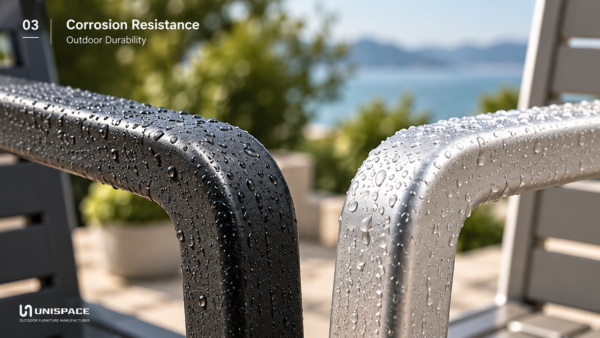
Outdoor exposure requires appropriate material and protective finishing specifications.
Steel: Protection Depends on the Complete System
Unprotected carbon steel may rust when moisture and oxygen reach its surface. For outdoor chair frames, resistance to corrosion depends on frame design, cleaning and pretreatment, protective finishing, and ongoing care.
Welds, sharp edges, tube openings, foot caps, and locations where moisture accumulates deserve particular attention. Suitable exterior powder coating can provide a protective barrier, but its performance depends on correct preparation, coating selection, application, and curing.
More demanding applications may justify additional protective measures, provided they are compatible with the frame design and finishing process.
Aluminum: Naturally Resistant, Not Immune
Aluminum forms a protective oxide layer, so it does not develop conventional iron rust. Nevertheless, it can suffer localized corrosion in certain environments, especially where moisture, chlorides, crevices, or incompatible metal connections are present.
Fastener selection, drainage, coating compatibility, and contact between dissimilar metals may all require attention.
Buying point: For coastal, poolside, or frequently cleaned furniture, evaluate the specific substrate, coating system, hardware, drainage, and maintenance requirements. Do not rely on the description “rust-resistant” alone.
4. Welding and Frame Construction
The reliability of a metal outdoor chair depends heavily on connection design and fabrication control.

Weld preparation, joint geometry and fabrication quality influence the performance of metal chair frames.
Steel tubing can be cut, bent, and welded with established manufacturing processes. Repeatable fixtures, well-planned weld locations, and careful inspection help control distortion and frame consistency. However, weld appearance alone cannot prove joint strength or fatigue performance.
Aluminum welding requires appropriate surface cleaning, filler selection, heat management, and joint design. Depending on the alloy and temper, the heat-affected zone may have different mechanical properties from the original base material. This should be considered in highly loaded frame areas.
For both materials, quality control should address:
- Weld location, joint preparation, and alignment.
- Appropriate weld procedures and inspection criteria.
- Distortion and dimensional consistency.
- Cleaning and protection around welded areas.
- Structural performance of the complete assembled chair.
A simpler frame with fewer welds may improve manufacturing efficiency, but weld count alone is not a quality standard.
Buying point: Evaluate the complete chair structure, not only an isolated weld or a material label.
5. Shipping, Packaging and Landed Cost
Factory price is only part of the sourcing equation. Freight, packaging materials, container utilization, assembly, and handling can change the landed cost substantially.
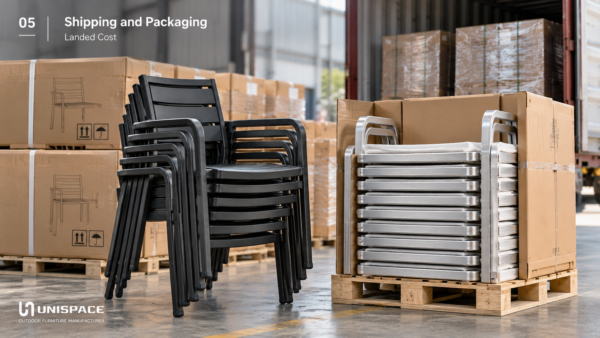
Stackable structures and optimized export packaging can improve transportation efficiency.
Aluminum chairs may offer a handling advantage because of their lower finished weight, especially where shipments are weight-limited. Yet many furniture shipments are constrained primarily by carton volume rather than mass.
A well-designed stackable or knock-down chair may fit more units into a container than a fully assembled chair with bulky packaging. This advantage is possible with either steel or aluminum, provided the structure and connections remain suitable for the intended application.
Before ordering, buyers should request finished and packed weights, carton dimensions, units per carton, container loading estimates, protective packaging details, and assembly requirements.
The best shipping configuration must also account for damage risk, hardware management, retail handling, and end-user assembly experience.
Buying point: Compare the landed cost per sellable unit—not just the factory price or the weight of the chair.
6. Matching the Frame to Your Product Positioning
A material decision should begin with the target retail range and use case rather than a country label. Steel and aluminum both have opportunities across international residential and commercial furniture markets.
Value-Oriented Residential Collections
For competitively priced outdoor dining and conversation sets, an efficient powder-coated steel frame may be worth considering. Material and production economics can support accessible price points when coating quality and packaging are properly specified.
Lightweight and Easy-to-Move Seating
Where low weight and frequent repositioning are selling points, aluminum may provide a meaningful advantage. This can be relevant for balconies, cafés, hospitality terraces, and furniture that needs to be stored or rearranged often.
Premium Contemporary Collections
Aluminum can support clean extruded profiles and lightweight designs, while steel can also produce refined contemporary forms through thoughtful tube geometry and finishing. Premium positioning depends on the complete design, finish quality, comfort, and customer expectations—not on the metal name alone.
Demanding Outdoor Applications
Coastal, poolside, and high-exposure settings require a closer review of the whole protective system. Aluminum may avoid conventional iron rust, but it still requires sound connection and corrosion-control details. Protected steel may also be appropriate when the system is correctly specified and maintained.
Across markets, terminology varies: for example, buyers may search for aluminum patio chairs or aluminium garden chairs. Product selection, however, should still be based on use conditions, verified performance, and commercial objectives.
7. Steel vs. Aluminum Outdoor Chairs: A Buying Comparison
The following comparison summarizes the main differences relevant to outdoor furniture sourcing.
| Factor | Steel Outdoor Chairs | Aluminum Outdoor Chairs |
|---|---|---|
| Material Cost | Often lower for conventional tubular designs | Often higher, depending on alloy and profile |
| Finished Weight | Typically heavier for comparable frame concepts | Typically lighter |
| Structural Design | High stiffness; efficient tubular structures | Lightweight profiles; geometry must be optimized |
| Corrosion Behavior | Carbon steel requires appropriate protection from rust | Natural oxide protection; localized corrosion remains possible |
| Welding | Established methods; weld and surface preparation matter | Alloy, oxide control, heat input, and weld-zone properties matter |
| Shipping | Carton volume and weight must both be assessed | Lower weight may help; carton volume still matters |
| Market Positioning | Competitive and versatile ranges | Lightweight and design-led ranges; not exclusively premium |
A Practical Supplier Checklist
Before comparing quotations, confirm the base metal grade and profiles, finished chair weight, joint details, surface treatment, packed dimensions, assembly method, expected use environment, and agreed performance tests.
A supplier comparison is meaningful only when the requirements are sufficiently similar.
8. Frequently Asked Questions
Are aluminum outdoor chairs better than steel chairs?
Not universally. Aluminum offers a weight advantage and does not form conventional iron rust. Steel can offer material-cost and stiffness advantages in suitable designs. The better option depends on the complete chair and its intended use.
Are steel outdoor chairs cheaper than aluminum outdoor chairs?
Often, but not always. Material price is only one input. Frame complexity, welding, coating, volume, and packaging all influence the factory quotation.
Which material lasts longer outdoors?
Neither has a guaranteed longer life in every environment. Durability depends on material grade, frame design, corrosion protection, maintenance, and manufacturing quality.
Are aluminum chairs suitable for commercial use?
Properly engineered aluminum chairs can be suitable for commercial seating. Their complete structure and connections should meet applicable performance requirements for the intended market and use.
Is one material always better for coastal furniture?
No. Aluminum avoids iron rust but is not immune to localized corrosion. Steel needs an appropriately specified protective system. Coastal performance should be evaluated at the system level.
Conclusion: Choose the Frame That Fits the Product
When comparing steel vs aluminum outdoor chairs, neither material is the universal winner.
Steel can support cost-efficient manufacturing and structurally versatile designs. Aluminum offers lower density and freedom from conventional iron rust, which can be valuable in lightweight seating collections.
The best result comes from aligning material choice with frame geometry, welding quality, protective finishing, packaging efficiency, expected exposure, and the product’s target price range.
At UNISPACE, we consider these factors together when developing metal-framed outdoor furniture for wholesale and OEM/ODM programs.
Ask Which Frame Suits Your Market.
If you are planning a new outdoor seating range, we welcome discussions about frame material, manufacturing specifications, protective finishes, and export packaging for your intended product positioning.