


Do More Welds Always Make a Chaise Lounge Stronger?

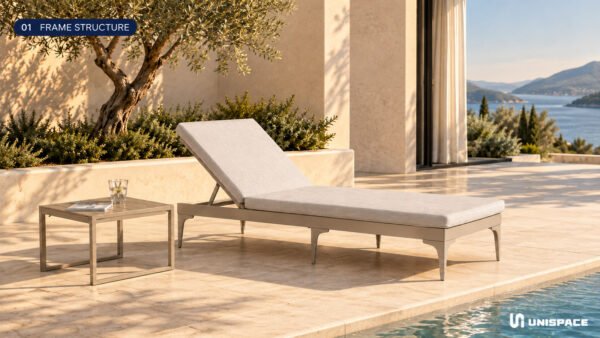
More welds do not automatically make a chaise lounge stronger. In a metal chaise lounge welding process, strength depends on where the joints are placed, how loads move through the frame, whether each weld is made correctly, and whether the finished geometry remains consistent.
A lounge chair must support someone sitting down, reclining, shifting weight and getting up. Staff may also move or stack it repeatedly. Welding a low-stress location more heavily will not fix the connection that actually carries the load. For a B2B buyer, the useful question is which joints are essential to the frame and how the manufacturer verifies them.
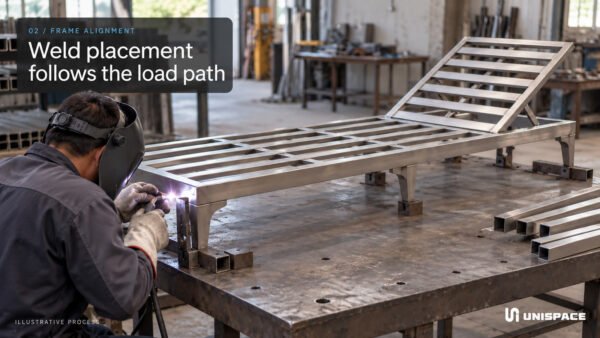
01 Follow the Load Path Before Counting Welds
Start with the way the chaise lounge is used. A person’s weight passes through the sling or seat supports into the side rails, cross members and legs. Changing the backrest angle introduces force through the adjustment mechanism and its connections. Moving the lounger adds another set of demands at the feet, handles or wheels.
This load path helps identify the connections that deserve particular attention. A neat weld in a low-stress location cannot compensate for a poorly designed joint near a leg, backrest pivot or heavily loaded cross member. Tube size, wall thickness, joint fit and overall geometry also matter.
An additional brace can improve a weak load path when its position and connections are properly designed. Simply adding several short welds to an unchanged layout is a different decision. Two outdoor chaise lounge frames with different tube geometry cannot be compared by counting visible beads in photographs.
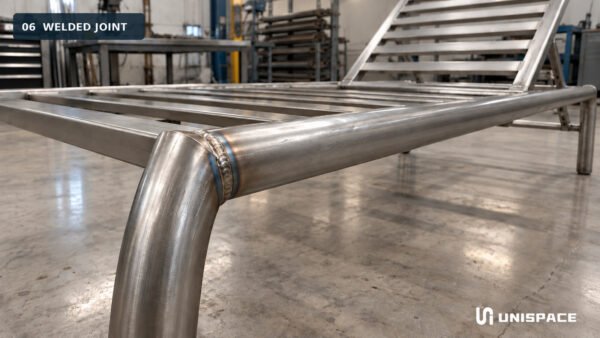
02 More Welding Can Mean More Distortion
Welding heats a local area of metal. As it cools, that area contracts. On a long, relatively light chaise lounge frame, an unsuitable weld sequence or unnecessary weld volume can pull rails out of alignment, twist a leg assembly or change the fit of the backrest mechanism.
The Welding Institute identifies joint design, fit-up, restraint and welding procedure among the factors that affect distortion. It also recommends limiting weld volume and balancing the sequence where appropriate. These are design and process decisions, rather than a reason to remove a necessary structural weld.
A small geometry change can become a practical defect: the chair may rock on a level floor, its backrest may move less smoothly, or stackable units may touch in the wrong places. Correcting those issues after welding adds rework and can affect appearance.
03 A Strong Sample Must Be Repeatable
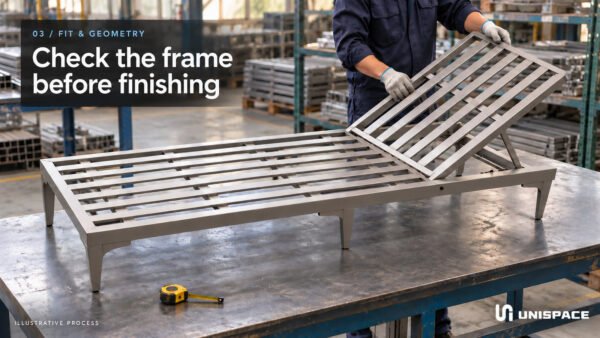
A single well-made sample is useful, but an importer needs the next production batch to follow the same specification. That starts before the weld is made: cut tubes need consistent lengths, bends need predictable angles, and parts should fit without forcing the welder to fill an avoidable gap with extra metal.
A fixture holds components in position, while a defined tack and welding sequence helps control movement. The approved sample should establish more than the silhouette. Production drawings can identify joint locations, key frame dimensions, backrest positions and clearances to check after welding.
For an adjustable or stackable welded chaise lounge frame, small variations across several connections may alter how a mechanism operates or how chairs stack. Repeatability is part of structural quality, not just a visual preference.
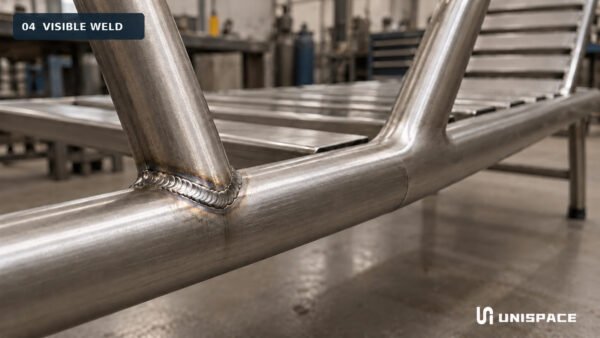
04 Grinding Changes Appearance Not Joint Design
Some buyers prefer a clean frame with few visible welds. Thoughtful tube bending, joint placement and controlled finishing can support that look. The desired appearance should be considered during development rather than left entirely to the grinding station.
Grinding may improve the appearance of an exposed joint when the method suits its design. It cannot turn an undersized, poorly fused or incorrectly located weld into a sound structural connection. Excessive cosmetic grinding may also make the original weld profile harder to evaluate.
A smooth joint is not proof of strength, and a visible weld is not proof of poor workmanship. Inspection should compare the actual joint with the approved weld specification and acceptance criteria, including size, length and surface condition.
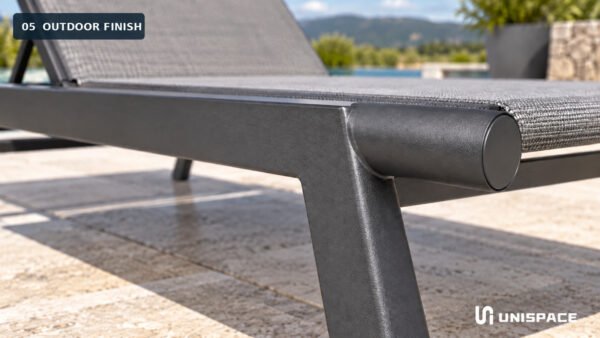
05 Outdoor Finishing Starts at the Welded Joint
A chaise lounge for a patio, resort or pool deck must be evaluated as an outdoor product. Welded intersections, tube ends and hard-to-reach corners need attention during surface preparation and coating. A clean finish on the most visible rail says little about coverage under the frame.
Ask how the factory cleans welded areas, handles spatter and sharp edges, applies the chosen coating system and checks difficult areas. The appropriate finish depends on real exposure: a covered patio, open pool deck and coastal location present different conditions.
The weld must serve its structural purpose; pretreatment and coating must suit the material, geometry and environment. Neither a large bead nor a thick-looking finish is a complete outdoor performance specification.
06 More Welds Also Affect Production Efficiency
Every added joint requires positioning, welding and inspection. It may also require cleaning, grinding or rework before finishing. If an extra joint provides no useful structural benefit, it adds cost and another opportunity for dimensional variation.
Efficiency should be reviewed across the entire process. A frame with fewer, well-placed joints may be easier to fixture and more consistent to produce. Another frame may genuinely need an additional brace. The decision belongs in design review and sample evaluation.
For OEM and ODM programs, adjusting a bend, connection detail or assembly sequence before bulk production can sometimes improve appearance and manufacturability together. The approved result should be documented so later batches follow it.
07 Buyer Checklist Before Sample Approval
When reviewing a poolside chaise lounge or another metal lounger, ask the manufacturer to show how the frame is designed and controlled. The approved sample should establish a production specification, not just a photograph.
| Check | Confirm |
|---|---|
| Use conditions | Residential, hospitality or commercial; movement and stacking frequency |
| Load path | Main rails, cross members, legs and adjustment connections |
| Joint specification | Weld locations, size, length and quality criteria |
| Frame geometry | Level points, key dimensions, backrest and stack clearances |
| Production control | Cutting, bending, fit-up, fixture and weld sequence |
| Visible finish | Grinding scope and post-grinding inspection |
| Outdoor finish | Pretreatment and coating at welded areas |
| Sample approval | Drawings, physical sample and performance checks |
08 A Better Question for Frame Development
The strongest-looking chaise lounge is not necessarily the one with the most welds. A reliable frame directs loads through suitable members and connections, holds its geometry after welding and can be reproduced through a controlled process.
Share the frame structure, intended use, backrest adjustment details, preferred appearance and stacking requirements. Those details give the manufacturer a sound basis to review joint placement before a sample is approved.
Learn more about UNISPACE manufacturing and read our buyer FAQ.