


The Most Overlooked Quality Points in PE Rattan Garden Chairs

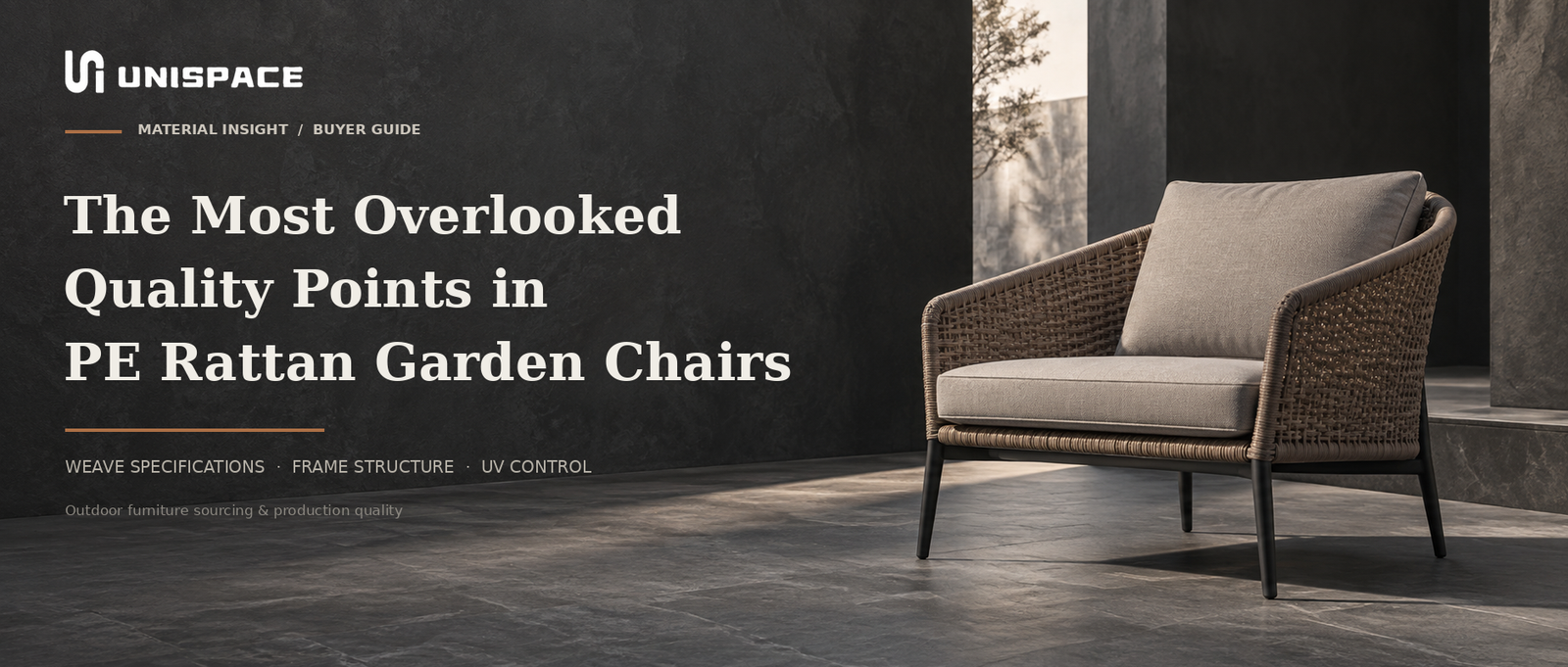
A rattan garden chair can look excellent in a showroom sample and still create problems once it moves into mass production.
For importers, wholesalers, retailers and outdoor furniture brands, confirming that the product uses PE rattan is important, but it is only the starting point. Two chairs can both be described as PE rattan garden furniture while performing very differently in appearance, production consistency and outdoor durability.
The difference often comes from details that are easy to overlook during sourcing: the rattan profile and thickness, colour consistency, weaving joints, the hidden metal frame and the actual UV requirement.
The more useful sourcing question is not simply whether the chair uses PE rattan. It is whether the full weave specification has been requested and approved.
01 Buyer Quick Answer
When evaluating a rattan garden chair, do not approve the product based only on weave appearance. Ask the supplier to define:
- PE rattan material and profile
- strand width, thickness or diameter
- surface texture and approved colour standard
- weaving pattern, density, tension and joint method
- internal frame material, tube dimensions and support layout
- surface preparation and powder-coating coverage
- UV, colour-fastness or weather-resistance requirement
- mass-production workmanship and inspection standard
A good-looking weave is easy to see. A repeatable weave specification is what makes the product suitable for commercial production.
02 PE Rattan Is Not a Complete Material Specification
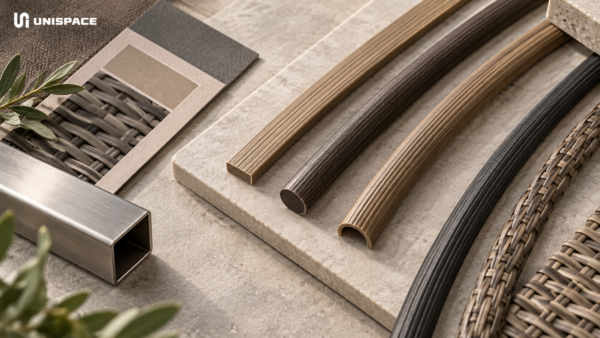
When a sourcing document says only Material PE Rattan, a large amount of information is still missing. Synthetic rattan can be produced in different profiles, widths, thicknesses, hardness levels, surface textures, gloss levels, embossing patterns and colour combinations.
Some products use flat rattan. Others use round, half round or mixed profiles to create a more natural appearance. Even within the same nominal colour, the surface can range from smooth and relatively plastic looking to matt, textured or multi tonal.
For a repeat programme, the approved strand should become part of the product specification. A physical material sample or master reference is more reliable than a general colour name such as natural brown, grey, beige or coffee. The practical question is whether the factory can reproduce the approved material consistently six months later.
03 Rattan Thickness Is Not Simply Better When It Is Heavier
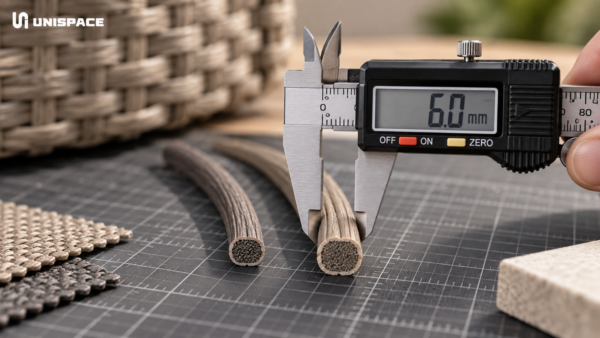
Rattan thickness is one of the first technical details worth checking, but more material does not automatically mean a better product. A heavier strand may create a fuller visual effect, yet it also changes flexibility, corner bending, weaving density, chair weight, production speed and material cost.
Very thick rattan can be difficult to wrap neatly around tight frame geometry. Very thin or poorly controlled strands can create inconsistent tension, visible gaps or a visually weak weave.
For flat rattan, buyers should define width and thickness. For round rattan, diameter should be controlled. For half round or special profiles, the cross section should be clearly identified. The objective is not to request the thickest strand, but to keep the approved dimension stable throughout production.
04 Colour Difference Is a Commercial Quality Issue
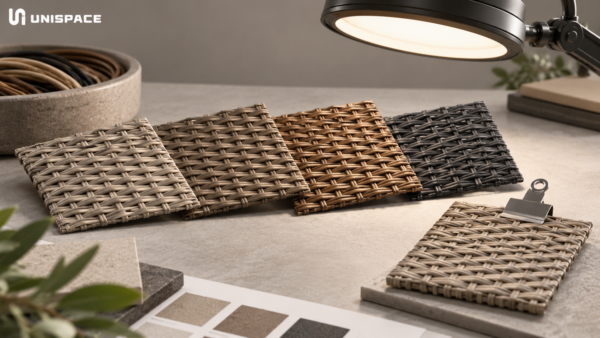
Colour consistency is particularly important for rattan garden furniture sold as sets. A customer may buy two or four dining chairs, a sofa set, an armchair with a matching table, or replacement pieces at a later date. Noticeable shade differences can make the whole set look inconsistent.
Natural look synthetic rattan often combines several tones to imitate natural fibres. That variation can be desirable. Uncontrolled variation is not. Buyers should distinguish between an intentional colour blend and batch to batch colour deviation.
A practical approval system can include an approved colour master, a physical rattan swatch, product photography, an acceptable shade range and comparison under consistent lighting. This is especially important for online retail, where delivered colour that differs from the product page can create dissatisfaction even when construction is acceptable.
05 Weaving Joints Reveal the Real Production Quality
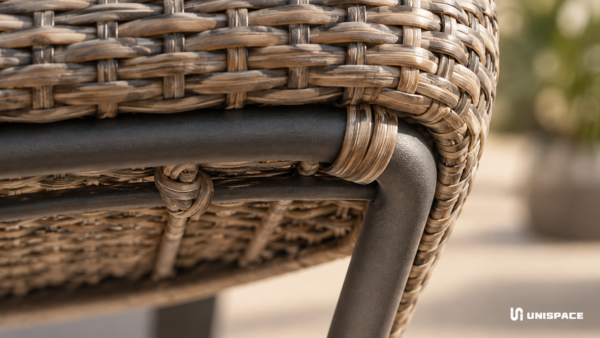
One of the fastest ways to inspect a woven chair is to stop looking at the front surface. Check underneath the seat, behind the backrest, around the corners and wherever one strand ends and another begins.
Synthetic rattan cannot always run continuously across every part of a complex chair. The relevant questions are where joints are positioned, whether loose ends are secured, whether a joint becomes bulky, whether a strand lifts away from the frame and whether tension remains stable around the joint.
A well developed product places joining points in less visible areas where the structure allows. The finishing method must also be repeatable. A beautifully woven approval sample is not enough if each production worker handles strand endings differently.
06 The Hidden Metal Frame Matters More Than It Appears
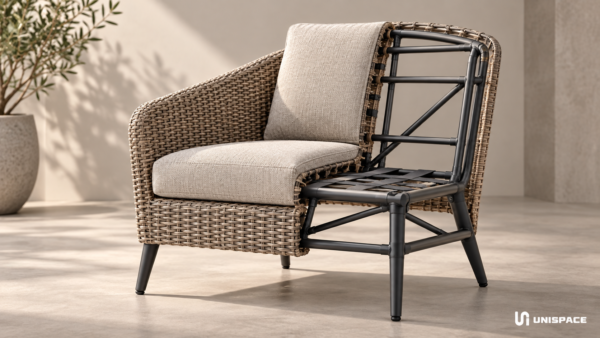
Customers see the weave. Manufacturers see the structure beneath it. For load bearing performance, the hidden metal frame is often the more important component.
Depending on positioning and cost targets, a PE wicker chair may use aluminium or coated steel. Neither should be judged by the metal name alone. Buyers should review tube dimensions, wall thickness, support layout, welding, surface preparation, powder coating coverage and the areas hidden by the weave.
The relationship between welding and weaving is easy to overlook. Weld spatter, rough grinding or unfinished tube edges can create abrasion points beneath the rattan. The consumer may never see them, but repeated movement can damage the strand over time. Frame quality and weaving quality therefore have to be evaluated together.
07 UV Resistance Should Be a Defined Requirement

UV resistant appears frequently in outdoor furniture descriptions. For a professional buyer, it should lead to a more specific question: UV resistant to what level and based on what evidence?
Outdoor synthetic rattan is exposed to sunlight, temperature changes, moisture, seasonal weather, cleaning and repeated mechanical use. UV stabilisation therefore matters to both colour retention and polymer performance.
Buyers can request the raw material type, a UV stabilisation statement, weathering or ageing information where available, colour fastness requirements and supplier test reports when the programme requires them. A seasonal promotional chair and a premium outdoor collection do not need identical specifications. The requirement should match the market, expected service life and price positioning.
08 Samples and Mass Production Can Look Different
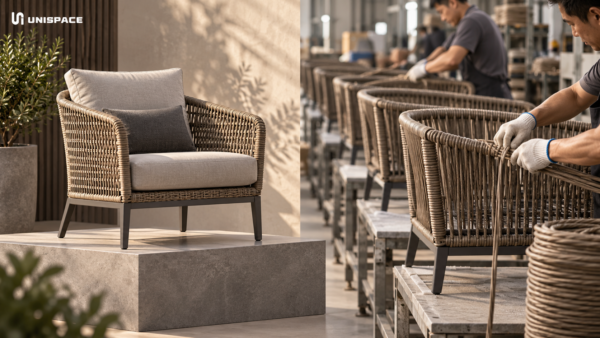
Rattan products are sensitive to the transition from sample making to mass production. A sample chair may be woven slowly by one experienced worker. Bulk production involves multiple workers, frame batches and material batches, while still requiring consistent tension, spacing and joint placement.
Weaving tension changes appearance and seat feel. Small spacing differences accumulate across a large backrest. Slight frame variation can alter gaps and tension. Material batches may differ in shade, flexibility or strand dimensions. Joint treatment can also vary if the finishing method is not documented.
Sample approval should therefore create a production standard. The approved chair, material swatch, colour master, joint method and workmanship criteria should be usable by production and inspection teams throughout the order.
09 What Buyers Should Put Into the Specification
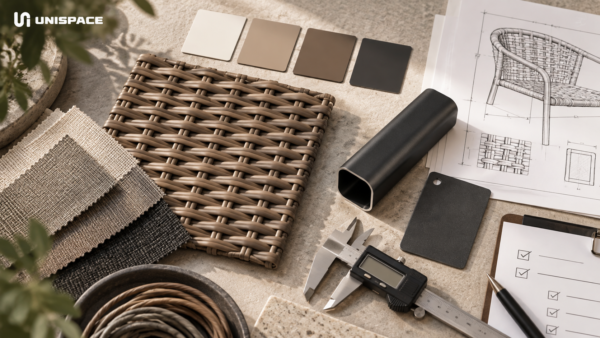
Before placing a bulk order for a rattan garden chair, buyers should confirm four groups of information. This documentation takes time at the beginning, but it normally prevents much more discussion after production starts.
| Control Area | What Buyers Should Define |
|---|---|
| Rattan material | PE or HDPE, profile, width, thickness or diameter, surface texture, finish and approved colour |
| Weaving | Pattern, direction, density or spacing, tension, joint location and edge finishing |
| Metal frame | Steel or aluminium, tube dimensions, wall thickness, support layout, welding, surface preparation and coating |
| Outdoor performance | UV requirement, colour fastness, weathering information and corrosion protection |
| Mass production | Approved sample, material swatch, colour master, workmanship, packing method and inspection criteria |
10 The Manufacturer View and Final Recommendation
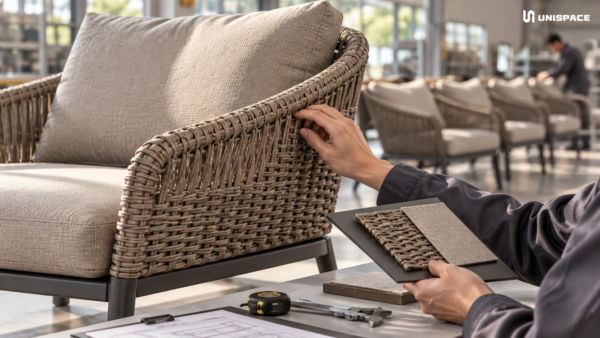
One of the biggest sourcing mistakes is to evaluate individual materials in isolation. A heavier strand does not compensate for poor weaving. Premium rattan does not compensate for an unstable frame. A strong frame does not solve visible colour variation. Good powder coating cannot protect a strand from a rough contact point beneath the weave.
For OEM and ODM programmes, the goal is not simply to make one attractive chair. It is to create a product that can be reproduced consistently across the whole order while meeting the target market, price and performance level.
Good product development balances appearance, structure, materials, manufacturability, cost and production consistency. That is why the most useful question during sourcing is not only whether the chair uses PE rattan, but whether the full weave and frame specification has been requested, approved and controlled.
Final Recommendation
When sourcing PE rattan garden furniture, do not stop at asking whether the material is PE rattan. Ask for the exact weave specification, approved colour standard, joint method, internal frame construction and the required meaning of UV resistant.
The most important quality problems in a rattan garden chair are often not visible in a product photograph. They are hidden in specifications that were never requested. Clear requirements at the sampling stage are one of the simplest ways to reduce inconsistency during mass production.
Developing a Rattan Garden Chair Collection?
At HUZHOU UNISPACE FURNITURE CO LTD, we work with overseas buyers on metal-frame outdoor furniture development, sampling and production. Buyers can share a product design, reference image, target market, expected order quantity, price positioning and material requirements so the frame structure, weave, finishing and production feasibility can be reviewed before bulk manufacturing.
For outdoor furniture product development, share your product design, target market and technical requirements before the chair moves into bulk manufacturing.
Request the weave specifications before approving the sample.
Frequently Asked Questions
Is PE rattan the same as natural rattan?
No. PE rattan is a synthetic polyethylene weaving material developed for outdoor furniture. Its profile, colour, texture and performance can be specified for repeat production, while natural rattan is a plant-based material with different outdoor limitations.
Does thicker PE rattan always mean better quality?
No. The correct thickness depends on the strand profile, frame geometry, weaving pattern and required appearance. Consistent dimensions and controlled tension are more useful than simply choosing the thickest strand.
How can buyers control colour differences in rattan garden furniture?
Approve a physical strand sample or colour master, define an acceptable shade range and compare production under consistent lighting. Intentional multi-tonal colour should be distinguished from uncontrolled batch deviation.
What should be checked underneath a woven chair?
Check frame dimensions, welding, grinding, coating coverage, sharp contact points, strand endings and joint security. Hidden workmanship can affect both structure and the long-term condition of the weave.
What does UV resistant mean for PE rattan?
It should be treated as a defined performance requirement rather than a general marketing phrase. Buyers can request material information, stabilisation statements, colour-fastness expectations and relevant weathering or ageing evidence when the programme requires it.