Square, Round or Shaped Tube: What Changes the Outdoor Sofa Design?

Quick Contents
- Why Tube Shape Matters in Outdoor Sofa Design
- Square Tube: Architectural and Structured
- Round Tube: Softer and More Continuous
- Shaped Tube: Creating a More Distinctive Identity
- Visual Weight Is Not Just About Tube Size
- How Tube Shape Changes Bending and Welding
- How Tube Selection Affects Production Cost
- Choosing the Right Tube for Market Positioning
- From Design Direction to a Manufacturable Sofa
- B2B Development Checklist Before Sample Approval
- Final Recommendation
The Quick Answer
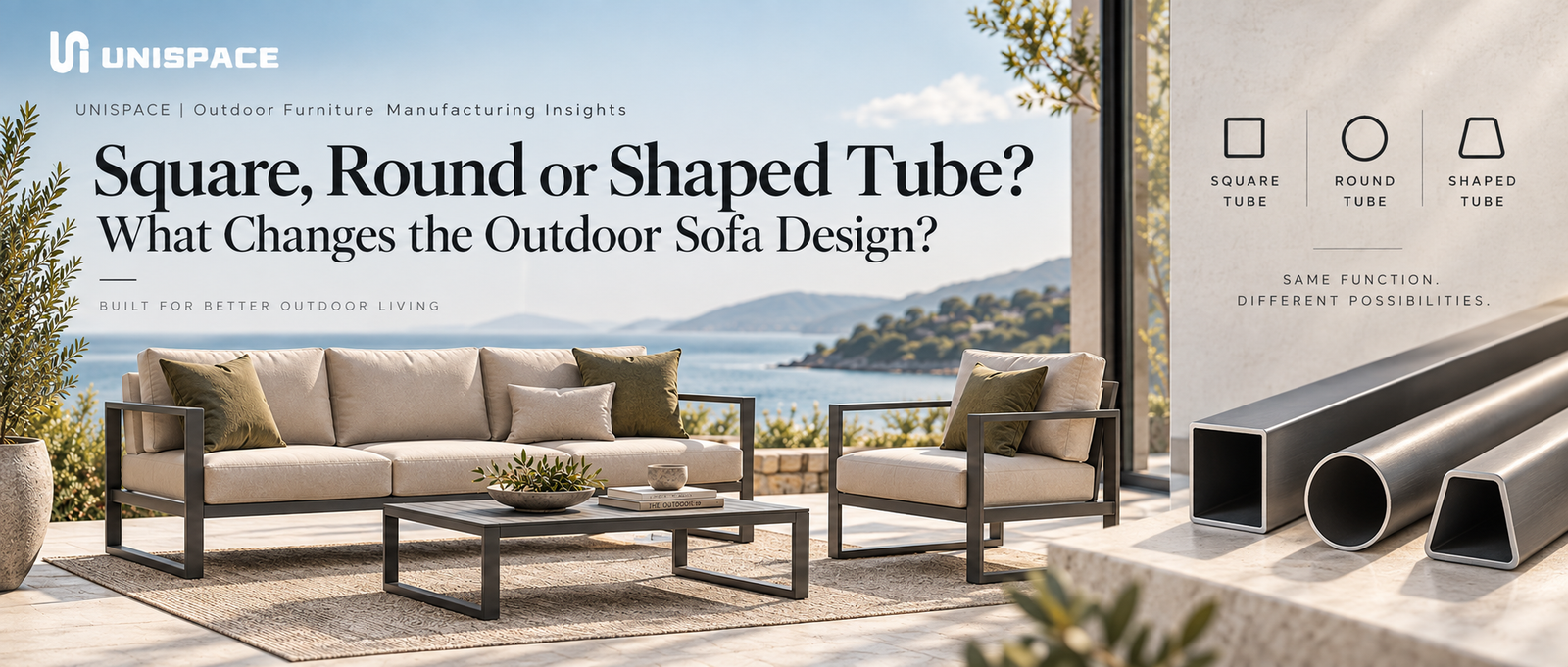
There is no single “best” tube shape for a metal outdoor sofa. Square tube tends to create a cleaner, more architectural and structured appearance. Round tube usually gives the frame a softer and more relaxed visual language. Shaped profiles can make a collection more distinctive, but they may require more specialized tooling, forming control and production planning. The right choice depends on product positioning, frame geometry, expected order volume, manufacturing capability, and target cost.
The key question: Which tube creates the right design language while still making sense in production?
1. Why Tube Shape Matters in Outdoor Sofa Design
The metal frame is the visual skeleton of an outdoor sofa. Even when most of the seating area is covered by cushions, the exposed legs, armrests, back frame, lower rails, and support members define the product’s character. A slim square frame can make a sofa feel precise and architectural. A continuous round frame can make the same overall volume feel softer and more relaxed. An oval or specially formed section can become a signature detail that separates a collection from standard market designs.
This distinction matters in custom outdoor sofa development because many products already share similar cushion proportions, neutral fabrics, and powder-coated finishes. The frame becomes one of the most effective places to create differentiation without rebuilding the entire furniture system. A tube decision made early can help a buyer maintain one design language across a single chair, two-seat sofa, three-seat sofa, sectional module, and coffee table.
For B2B projects, the best tube choice should therefore connect four questions: What should the collection look like? How will the frame be formed? How repeatable is the welding and finishing process? And does the resulting cost match the target market?
2. Square Tube: Architectural and Structured
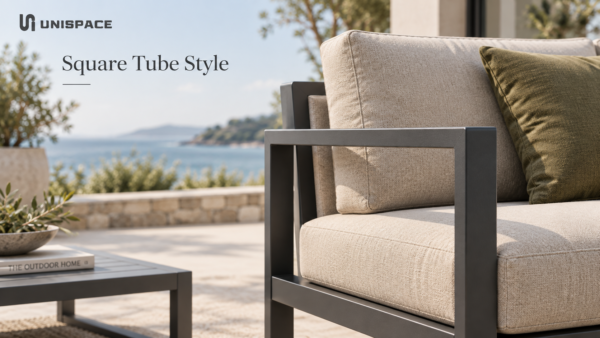
Square and rectangular tubes are closely associated with modern metal outdoor sofas because their straight surfaces and defined edges create a controlled, architectural appearance. They work particularly well for minimalist collections, modular systems, contemporary hospitality furniture, and conversation sets where the frame should look systematic rather than decorative.
Square tube also makes the relationship between horizontal and vertical members easy to read. A well-designed armrest can visually continue into the front leg and lower rail, creating one coherent geometric language. For brands that want a clean product family, this clarity can be a major advantage.
The same clarity can expose manufacturing weaknesses. Flat surfaces make joint alignment, weld placement, corner accuracy, and grinding marks easier to see. On a premium frame, a poorly positioned weld can interrupt the visual line even if the structure is technically strong. This is why joint locations, fixture accuracy, and post-weld finishing should be considered during design rather than treated as corrections after the first sample.
3. Round Tube: Softer and More Continuous
Round tube communicates a different character. Without sharp edges, the frame often appears softer, lighter, and more approachable. It is especially suitable for curved armrests, wraparound backs, rounded corners, relaxed lounge proportions, rope details, and designs that need a more organic silhouette.
Round tube also works naturally with many bending operations. A single tube can sometimes move from a leg into an armrest or back support through controlled bends, reducing the number of visible joints. When this is done well, the result can look cleaner than a frame built from several short components. A curved metal outdoor sofa often benefits from this continuity because the frame can follow the arc of the seating more naturally.
However, a visually simple curve can still require significant process control. Bend radius, tube diameter, wall thickness, springback, ovalization, and fixture positioning all affect whether multiple curved parts meet correctly in the final welded assembly. Small deviations that are almost invisible in one component can accumulate across a full sofa frame.

4. Shaped Tube: Creating a More Distinctive Identity
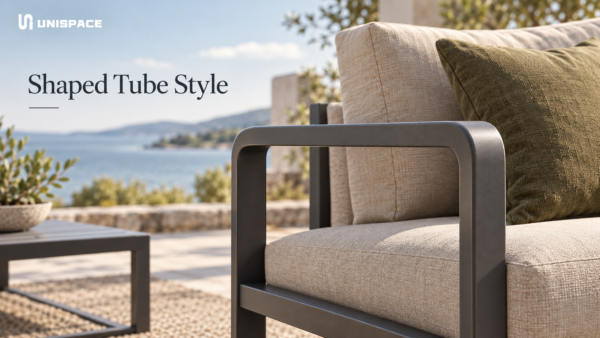
Between standard square and round tubing sits a broad category of shaped profiles: oval tubes, flattened tubes, racetrack sections, soft-corner rectangles, and other non-standard cross-sections. Their main advantage is not complexity for its own sake; it is the ability to create a recognizable frame detail without adding decorative components.
A shaped profile can make an armrest appear slimmer, soften the transition between surfaces, or change how light moves across the frame. For a brand developing custom metal outdoor furniture, this can help a collection feel more proprietary even when the overall sofa dimensions remain commercially familiar.
The manufacturing consequences must be evaluated early. A special profile may involve minimum material quantities, dedicated bending tooling, orientation control, custom fixtures, and tighter inspection. With round tube, rotational orientation may not matter visually. With an oval or asymmetric tube, a few degrees of rotation can make adjacent parts look inconsistent. A distinctive profile creates value only when it can be reproduced consistently at the expected order volume.
5. Visual Weight Is Not Just About Tube Size
Buyers sometimes compare frames only by nominal dimensions: 25 mm versus 32 mm, for example. But perceived visual weight depends on much more than one measurement. Tube section, exposed frame length, cushion thickness, armrest height, leg angle, spacing between members, powder-coating color, and surrounding negative space all influence whether a frame feels heavy or light.
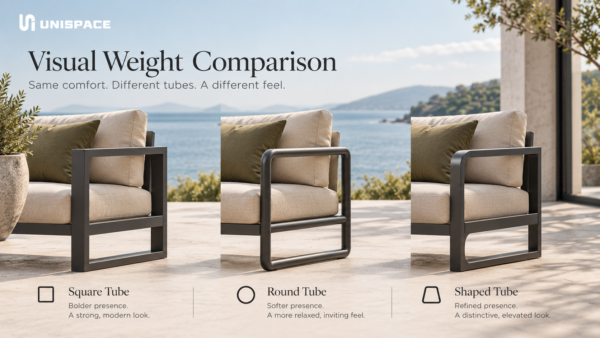
A dark square tube with broad flat faces can appear visually stronger than a round tube of a similar overall diameter because edges create more obvious boundaries. Round tube often feels softer because light transitions continuously across the curved surface. A shaped tube may look slim from one angle and substantial from another.
The correct comparison should therefore be made at collection level. A metal outdoor sofa set should maintain consistent visual proportions across different seating sizes and matching tables. If the three-seat sofa looks balanced but the same tube overwhelms the lounge chair, the section may need to change or be used selectively.
6. How Tube Shape Changes Bending and Welding
Design drawings can make different tube shapes look equally easy to manufacture. In reality, each profile behaves differently during cutting, bending, fixturing, welding, and finishing. Square and rectangular tubes require control of flat surfaces and corners during bending; poor forming can create twist, wall collapse, or inconsistent radii. Round tube is naturally compatible with continuous bends, but springback and wall deformation still need control.
Shaped profiles usually require the most process planning because orientation itself becomes part of the appearance. Tooling must support the profile correctly, and operators or automated equipment must maintain rotational position through bending and assembly. Welding fixtures then need to locate the part without marking or distorting its visible faces.
For a custom outdoor sofa manufacturer, design-for-manufacturing means reviewing not only the CAD model but also how each component will actually move through production. A small adjustment in tube direction, bend radius, or joint location can preserve almost the same design while improving repeatability and reducing finishing work.

7. How Tube Selection Affects Production Cost
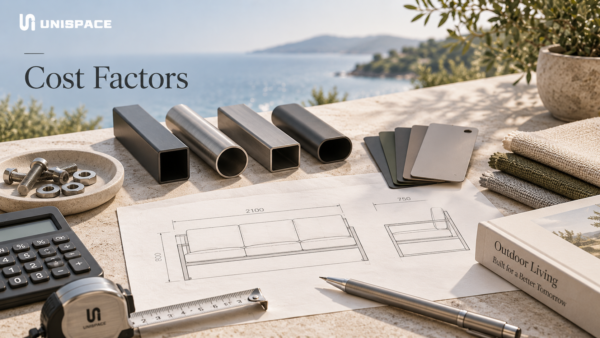
Tube price is only one part of the final product cost. Material availability, cutting operations, number of bends, tooling, welded joints, fixtures, grinding, tolerance control, rejection risk, production speed, surface treatment, assembly, and packaging all influence the total. This is why comparing price per meter can be misleading.
Consider two side-frame concepts. One uses a slightly more expensive tube but forms the visible side from one continuous bent component. The other uses a cheaper standard tube but requires several short pieces, multiple welds, more grinding, and more inspection. Depending on volume and geometry, the first option may actually be more efficient. The opposite can also be true: a sophisticated custom profile may look excellent in a sample but make little commercial sense for a small order if tooling and minimum material quantities are high.
For B2B development, the correct target is not the cheapest tube. It is the most efficient structure that delivers the intended appearance, strength, production stability, and price position.
8. Choosing the Right Tube for Market Positioning
The tube direction should reflect where the product will compete. Slim square or rectangular tube works naturally for minimal modern collections. Round tube often suits soft contemporary and organic lounge programs. Shaped sections can support a more recognizable premium identity. Modular commercial furniture often benefits from clear square or rectangular geometry because it communicates order and makes repeated modules feel systematic.
These are design tendencies, not fixed rules. A square tube can be softened through rounded corners, warm powder-coat colors, and thick cushions. A round tube can become highly architectural when used in a precise geometric frame. What matters is consistency between structure, material, upholstery, color, and market positioning.
Before approving a direction, buyers should compare not only mood boards but also sample frames. A full-size prototype reveals how the tube interacts with cushion volume, seat height, armrest proportion, and human scale in a way that a small material swatch cannot.
| Product Direction | Tube Direction to Explore | Typical Visual Effect |
|---|---|---|
| Minimal modern | Slim square / rectangular tube | Clean, architectural, controlled |
| Soft contemporary | Round tube | Smooth, relaxed, approachable |
| Organic lounge | Round / curved shaped tube | Flowing and comfortable |
| Premium collection | Shaped / mixed profiles | Distinctive and refined |
| Modular commercial | Square / rectangular tube | Structured and systematic |
| Curved statement sofa | Round / shaped tube | Continuous and sculptural |
9. From Design Direction to a Manufacturable Sofa
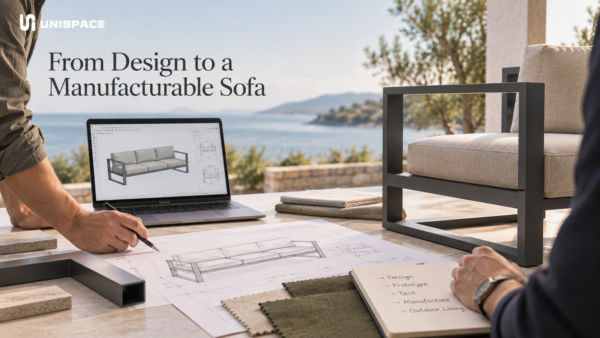
For OEM and ODM projects, tube selection should be tested through a practical development sequence. Start with the target market, use environment, expected order quantity, price position, and desired visual character. Then establish sofa proportions and candidate tube sections before finalizing visible frame areas.
The manufacturer should review bend feasibility, joint locations, structural support, load paths, drainage, surface treatment access, and fixture strategy. After the prototype frame is built, the team should check alignment, comfort, cushion clearances, weld appearance, stability, assembly, packaging, and loading efficiency. A frame that looks clean in a 3D model may require too many welds; a dramatic curve may need tooling that does not match the order volume; an extremely slim profile may need hidden reinforcement elsewhere.
A professional development process identifies these conflicts before mass production. For importers and brands, this is one of the clearest differences between buying a market-ready item and developing a custom product that can be reproduced reliably over multiple orders.
B2B Development Checklist Before Sample Approval
- Define the target market, use environment, target retail position, and expected order quantity.
- Confirm the tube section, nominal size, wall thickness, and whether any profile requires special MOQ or tooling.
- Review all visible weld locations and decide where continuous bending can reduce joints.
- Check bend radii, tube orientation, fixture strategy, drainage, and surface-treatment access.
- Approve the full-size prototype for appearance, comfort, stability, alignment, and cushion clearances.
- Review packaging and container efficiency before freezing the structure for mass production.
- Keep the approved frame specification, coating standard, and critical dimensions consistent for repeat orders.
For related development services, see our OEM outdoor furniture capabilities.
Final Recommendation
Square, round, and shaped tubes are not simply different raw-material choices. They are different design languages, and each one changes the manufacturing logic behind the sofa. The strongest direction is the one where appearance, structure, process, and commercial positioning support each other. The objective is not to create the most complicated frame; it is to create a frame that looks distinctive, performs properly, and can be reproduced consistently in mass production. At UNISPACE, we develop metal-frame outdoor furniture from a manufacturing perspective, supporting OEM and ODM projects from structural review and sampling through production and export preparation. If you are exploring a distinctive frame direction for a new outdoor sofa collection, share your reference design, target market, expected quantity, and price positioning so the frame concept can be evaluated before tooling and sampling begin.
UNISPACE manufacturing perspective: A distinctive outdoor sofa starts with the silhouette. A manufacturable outdoor sofa starts with the structure behind it.
Developing a Custom Metal Outdoor Sofa?
Share your reference design, target market, expected quantity, and price positioning. We can review the frame direction from both design and manufacturing perspectives before tooling and sampling begin.