


Curved Outdoor Sofa Design Guide: Round, Modern and Small-Space Options


A curved outdoor sofa adds visual flow, social comfort, and a softer architectural line to patios, terraces, and hospitality spaces. From a statement round outdoor sofa for an open resort terrace to a small curved outdoor sofa for a compact patio, the right design depends on radius, module size, frame engineering, cushion construction, and how people move through the space.
Quick Contents
- What Is a Curved Outdoor Sofa?
- Curved vs. Round Outdoor Sofa
- Why Curved Sofas Work in Modern Outdoor Spaces
- Curved Outdoor Sofas for Small Patios
- Recommended Frame and Cushion Materials
- Standard Dimensions and Seating Capacity
- Custom Curved Outdoor Sofa Manufacturing Options
- How to Source Curved Outdoor Sofas from a Manufacturer
1. What Is a Curved Outdoor Sofa?
A curved outdoor sofa uses an arched, semicircular, or fully rounded seating line instead of a conventional straight frame. The curve may be built into one welded frame, divided into several modules, or created by connecting wedge-shaped seating units.
The visual effect is softer and more inviting than a straight sofa. It reduces hard corners, encourages people to face one another, and helps the seating composition follow circular fire pits, round coffee tables, pool edges, planters, and curved architectural features.
From a manufacturing perspective, the design is more complex than it appears. The arc radius must remain consistent across the steel or aluminum frame, seat platform, backrest, cushion pattern, and connecting hardware. Even a small mismatch can create uneven gaps between modules or a back cushion that does not sit correctly.

2. Curved vs. Round Outdoor Sofa
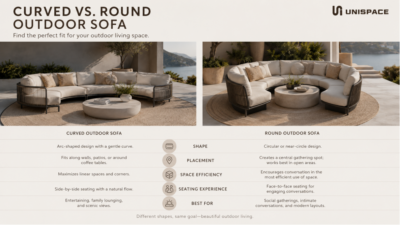
The terms curved outdoor sofa and round outdoor sofa are often used interchangeably, but they describe different layouts.
A curved sofa normally forms a partial arc, while a round sofa creates a complete or nearly complete circle.
A partial curve is easier to place against a wall, railing, pool boundary, or open landscape edge. It can be supplied as a left curve, right curve, or symmetrical center arc.
A fully round configuration needs more clearance, but it creates a strong social focal point and works especially well around a fire table or large circular coffee table.
For most residential patios and commercial terraces, a modular curved design offers greater flexibility. Buyers can combine two, three, or more units to create different radii without committing to one permanent circular footprint.
| Feature | Curved Outdoor Sofa | Round Outdoor Sofa |
|---|---|---|
| Shape | Partial arc or shallow curve | Complete or near-complete circle |
| Placement | Along walls, railings, pools, or landscape edges | Best in open central spaces |
| Space efficiency | Easier to adapt to different layouts | Requires more surrounding clearance |
| Seating experience | Side-by-side seating with natural visual flow | Face-to-face social seating |
| Best applications | Patios, balconies, poolside areas, and lounges | Resorts, large terraces, and fire-pit areas |
3. Why Curved Sofas Work in Modern Outdoor Spaces
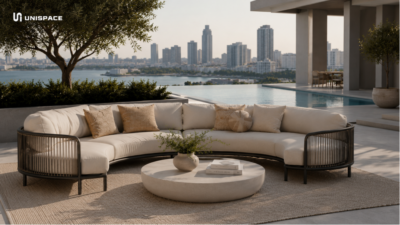
A modern outdoor sofa is expected to do more than provide seating. It should define the space, support circulation, and connect furniture with the surrounding architecture.
Curved furniture performs these tasks particularly well.
First, the arc guides movement around the seating zone and removes protruding corners from circulation routes. This can be useful on terraces, beside pools, or in hospitality spaces where guests frequently move around the furniture.
Second, it improves conversation. People seated on a curved sofa naturally face slightly toward the center rather than sitting in one straight line.
Third, the softer geometry balances the strong horizontal and vertical lines commonly found in façades, decking, pergolas, doors, and glass railings.
Curved silhouettes also match current organic-modern design language. Slim powder-coated metal frames, neutral cushions, rounded coffee tables, and low-profile backs create a contemporary appearance without relying on excessive decoration.
Steel tube bending is particularly useful for this style because it allows manufacturers to create controlled radii, slim profiles, and repeatable modules at commercially realistic costs.
4. Curved Outdoor Sofas for Small Patios
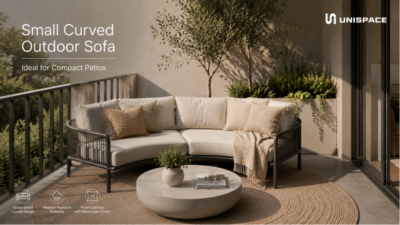
A small curved outdoor sofa can work successfully in a compact space, but the radius must be selected carefully.
A very deep or dramatic curve may consume more floor area than a straight loveseat. A shallow arc, by contrast, can soften the layout while preserving walking space.
For compact patios, begin with the usable circulation zone rather than the sofa itself.
Where possible, maintain approximately:
- 750–900 mm of clear passage on primary walking routes;
- 350–450 mm between the sofa edge and a coffee table;
- sufficient clearance for doors, sliding panels, and storage access.
These are practical planning ranges rather than universal rules. Accessibility requirements and local project standards may require additional space.
Two- or three-seat modules with an overall width of approximately 1,600–2,200 mm and a depth of 750–900 mm are common starting points for compact residential settings.
Armless end modules, removable side tables, and nesting coffee tables can reduce the total footprint further.
A shallow curved sofa can also make a small terrace appear more spacious by reducing visual corners and directing attention toward the center of the seating area.
5. Recommended Frame and Cushion Materials
Powder-Coated Steel Frames
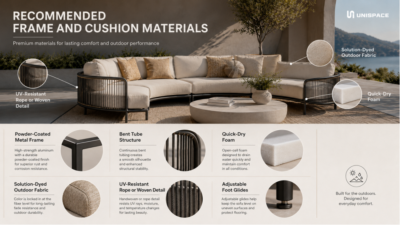
Powder-coated steel is a strong option for a curved outdoor sofa because it combines rigidity, wind stability, formability, slim frame potential, and cost efficiency.
Steel tube can be bent into repeatable arcs and welded into relatively narrow structural frames.
For outdoor use, however, the frame should include proper pretreatment, exterior-grade polyester powder, protected welds, open drainage paths, and replaceable foot glides.
The quality of the complete coating system is more important than the visible color alone.
Aluminum Frames
Aluminum is lighter and naturally resistant to red rust. It is useful for coastal residential projects or furniture that must be moved frequently.
Because aluminum is less stiff than steel, larger tube dimensions or additional structural reinforcement may be required to achieve similar rigidity.
Rope, Wicker, and Mixed Materials
- UV-resistant rope;
- PE wicker;
- wood-plastic slats;
- upholstered side panels;
- decorative metal mesh.
These materials can soften the visual appearance of the frame and add texture to a modern collection.
Cushion Construction
For cushions, common outdoor specifications include quick-dry foam or reticulated foam in highly exposed applications.
Suitable cover materials may include solution-dyed acrylic, olefin, or another tested outdoor fabric.
Comfort depends on more than foam thickness. Important factors include foam density, compression resistance, seat depth, backrest angle, cushion ventilation, and drainage performance.
Removable covers and ventilated cushion bottoms improve maintenance and help the cushions dry more efficiently.
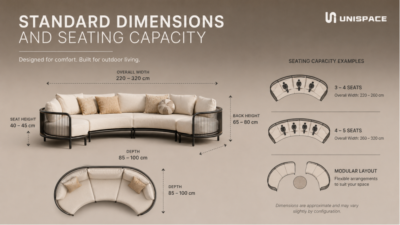
6. Standard Dimensions and Seating Capacity
There is no single standard size for a curved sofa because the radius and number of modules change the assembled footprint.
| Dimension | Typical Range |
|---|---|
| Seat height | 400–460 mm |
| Seat depth | 520–620 mm |
| Finished sofa depth | 750–950 mm |
| Back height | 680–850 mm |
| Seating width per person | 550–650 mm |
A compact curved loveseat may seat two to three people.
Medium modular arcs commonly seat four to five people, while large semicircular or round arrangements can accommodate six to ten people or more.
Buyers should request both the dimensions of each module and the dimensions of the fully assembled arrangement.
- inner radius;
- outer radius;
- complete width;
- complete depth;
- module angle;
- seat width per person;
- clearance between sections.
A product may appear compact in an individual module drawing but require significantly more space after all curved sections are connected.
7. Custom Curved Outdoor Sofa Manufacturing Options
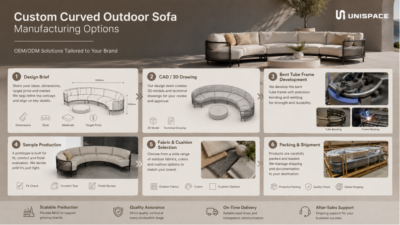
Curved products are well suited to OEM and ODM development because many details can be adapted to a specific collection.
- arc radius;
- module quantity;
- left- or right-facing curves;
- armrest design;
- frame tube section;
- seat and back height;
- cushion profile;
- rope or wicker pattern;
- fabric color;
- powder-coating color;
- connector design;
- packaging method.
A manufacturer should confirm the target market, intended application, load requirements, available patio dimensions, packaging restrictions, and expected price range before finalizing the design.
- design brief and dimensional requirements;
- 2D technical drawings;
- 3D modeling;
- prototype frame production;
- seating and comfort trials;
- cushion-pattern adjustment;
- packaging and loading tests;
- final production approval.
For metal-frame programs, important manufacturing capabilities include tube laser cutting or sawing, controlled tube bending, fixture-based welding, grinding, surface pretreatment, powder coating, cushion-pattern development, final assembly, and export packaging.
Modular construction can improve container utilization and reduce the risk of oversized cartons.
It can also make installation, replacement, and future expansion easier for commercial customers.
8. How to Source Curved Outdoor Sofas from a Manufacturer
A professional sourcing process should begin with more than a product photo.
- target dimensions;
- expected seating capacity;
- reference style;
- preferred frame material;
- usage environment;
- target market;
- order quantity;
- required standards;
- packaging requirements;
- target price range.
Ask the supplier to explain the arc construction, tube dimensions, wall thickness, welding method, drainage design, pretreatment process, powder type, cushion specification, fabric performance, connector design, and assembled tolerances.
For modular products, verify whether each unit aligns securely on uneven outdoor flooring and whether the connectors can be replaced.
- comfort;
- stability;
- cushion gaps;
- frame alignment;
- color consistency;
- water drainage;
- carton protection;
- assembly instructions;
- loading efficiency.
A reliable manufacturer should identify production risks during product development rather than after the furniture reaches the buyer’s market.
Final Recommendation
The best curved sofa is not simply the design with the most dramatic shape.
It is the design that fits the available space, supports natural conversation, maintains comfortable circulation, and can be manufactured consistently.
For compact patios, choose a shallow modular arc.
For large social spaces, consider a semicircular or round outdoor sofa.
For value-focused commercial programs, a properly engineered powder-coated steel frame offers an effective balance of strength, design flexibility, stability, and cost.
The final decision should consider not only appearance, but also frame engineering, coating quality, cushion drainage, module connection, packaging volume, and the actual usage environment.