


Steel vs Aluminum Outdoor Furniture: Which Is Better?

Steel vs Aluminum Outdoor Furniture: Which Is Better?
Aluminum vs steel outdoor furniture is not a simple contest between a “rust-proof” metal and a “strong” one. The better choice depends on frame geometry, wall thickness, welding, coating, drainage, climate, handling frequency, and target price. This manufacturer-level comparison explains where each material performs best—and why properly engineered powder-coated steel remains highly competitive for many outdoor furniture programs.
The Quick Answer
For buyers deciding between aluminum or steel for outdoor furniture, aluminum is usually the better option when low weight, frequent movement, or reduced rust risk is the priority. Steel is generally stronger and stiffer for the same section size, feels more stable in wind, supports slimmer structural profiles, and often delivers a lower total product cost.
The most accurate answer is application-specific: good structure and finishing can matter more than the base metal alone.
1. Material Performance: More Than the Name of the Metal
Most products sold as “iron outdoor furniture” are manufactured from low-carbon steel tube, sheet, wire, or rod. Steel is compatible with laser cutting, sawing, stamping, tube bending, robotic welding, and decorative wire or mesh work. These processes make it highly adaptable for dining chairs, loungers, benches, swing chairs, sofas, and contract furniture.
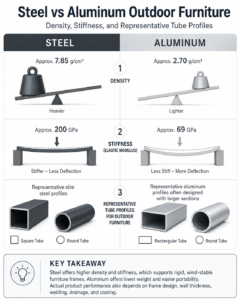
Outdoor aluminum furniture is commonly produced from extruded profiles, cast components, or sheet. Because aluminum has a lower elastic modulus than steel, manufacturers often compensate with larger tubes, thicker walls, ribs, or gussets.
As a reference, aluminum has a density of about 2.70 g/cm³, compared with roughly 7.85 g/cm³ for carbon steel. Steel’s elastic modulus is about 200 GPa, while aluminum is approximately 69 GPa. In practical terms, aluminum is around one-third of the weight by volume, but steel is close to three times as stiff at an equivalent cross-section. These figures are engineering references—not substitutes for checking the actual alloy, steel grade, wall thickness, and frame design.
2. Strength and Durability
When buyers ask is aluminum or steel better for outdoor furniture, strength is often the first consideration. Steel normally offers greater resistance to bending and flexing at the same dimensions. This is especially useful for long bench spans, narrow chair legs, cantilever structures, heavy tabletops, and furniture intended for frequent commercial use.
For comparison, 6063 aluminum extrusion has minimum yield strengths of roughly 110 MPa in common T5 conditions and about 172 MPa in T6 conditions, depending on product form and thickness. A common structural steel reference grade starts around 235 MPa. Furniture performance, however, depends on much more than nominal yield strength. Weld penetration, heat-affected zones, hole placement, joint geometry, fasteners, and load distribution can determine whether a frame remains stable after thousands of use cycles.
A useful steel vs aluminum outdoor furniture durability review should therefore include tube size, wall thickness, static load testing, cyclic durability testing, impact resistance, and stability. EN 581 is widely used for evaluating the mechanical safety of outdoor seating and tables for domestic, camping, and contract applications.
3. Corrosion Resistance
Aluminum has a natural advantage because its surface forms a protective oxide film. It does not develop red rust in the same way as carbon steel, so it is often preferred for coastal homes, poolside areas, and humid climates where owners want minimal corrective maintenance.
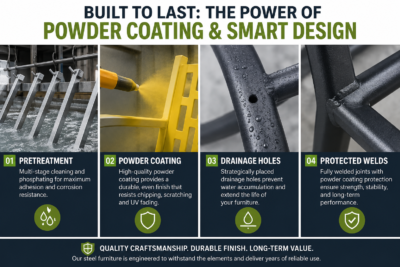
Steel requires a complete corrosion-protection system. In professional production, this may include degreasing, rinsing, conversion pretreatment, optional zinc-rich primer or electrophoretic coating, and an exterior-grade polyester powder topcoat. Weld seams, tube ends, drainage points, bolt holes, and contact areas require particular attention because corrosion often starts where moisture remains trapped or the coating is damaged.
When sourcing steel & aluminum powder coated outdoor patio furniture, do not compare powder color alone. Ask the supplier to define pretreatment, coating chemistry, dry-film thickness, adhesion, impact resistance, and the test acceptance criteria. Many outdoor furniture specifications use a powder thickness in the approximate range of 60–100 μm, but a thick coating over poor pretreatment may fail earlier than a thinner, well-bonded system.
Salt-spray data should also be interpreted carefully. ASTM B117 defines the test environment and operating procedure, but it does not prescribe a universal exposure period or tell buyers how many real outdoor years a certain number of test hours represents. A valid claim should identify the substrate, pretreatment, coating layers, scribe method, test duration, and acceptable rust or blistering level.
4. Weather, Rain, Wind, and UV Exposure
Outdoor weather resistance includes more than corrosion. Furniture must manage wind loads, rainwater, ultraviolet exposure, temperature cycles, freeze-thaw conditions, and ground contact.
Steel’s higher mass is beneficial on exposed terraces, rooftop restaurants, resorts, cafés, and windy gardens. It gives chairs and tables a planted feel and reduces unintended movement. Aluminum is easier for staff or homeowners to reposition, but very light furniture may require a wider footprint, linking devices, or concealed weights in demanding locations.
Both materials need intelligent water management. Drainage holes should sit at low points, tube ends should be protected, and the frame should avoid cavities that collect water. Outdoor-grade finishes, suitable fasteners, and replaceable glides also affect service life.
5. Maintenance Requirements
Aluminum normally requires less rust-related maintenance. Regular washing removes salt, dust, bird droppings, sunscreen, and airborne pollution. If the coating is scratched, the exposed aluminum may oxidize, but it will not produce the expanding red rust associated with steel.
Powder-coated steel should be inspected periodically, especially at feet, welds, stacking points, screw holes, and edges. Small chips are usually straightforward to repair: remove loose corrosion, clean the area, apply a suitable primer, and touch up the finish before damage spreads. For coastal projects, frequent fresh-water cleaning and scheduled coating inspections are worthwhile for both metals.
6. Weight and Portability
Aluminum’s low density makes it the natural choice for furniture that is carried daily, rearranged around pools, placed on small balconies, or shipped where freight weight is a major cost driver. Lightweight chairs can also reduce labor for event venues and hospitality teams.
Steel is heavier, but that is not automatically a disadvantage. For permanent dining areas, public terraces, and windy commercial spaces, additional mass improves stability and perceived solidity. When evaluating steel or aluminum outdoor furniture, buyers should decide whether mobility or stability matters more in actual use.
7. Surface Temperature and Comfort
Aluminum transfers heat faster than carbon steel. Typical aluminum alloys have substantially higher thermal conductivity, so their surface temperature responds more quickly to sunshine, shade, and ambient air. Nevertheless, the substrate is only one part of the comfort equation.
Dark colors absorb more solar energy than light colors, and direct contact with a metal seat or armrest matters more than the frame hidden below a cushion. For either material, comfort can be improved with textilene, rope, cushions, wood, wood-plastic slats, ventilated mesh, or lighter powder-coat colors. In hot climates, product design and surface color are often more important than simply choosing outdoor furniture steel vs aluminum.
8. Design Style and Forming Possibilities
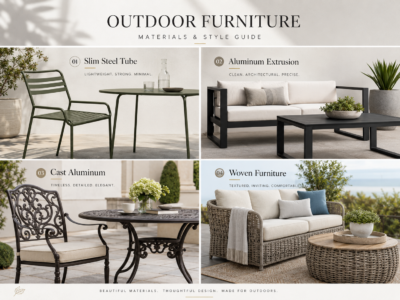
Steel gives designers broad freedom. It can be formed into slim tubular frames, curved structures, wire chairs, expanded-metal surfaces, perforated panels, decorative scrolls, and mixed-material collections. Because steel is stiff, visually light sections can remain stable without becoming excessively bulky.
Aluminum extrusion is excellent for crisp architectural lines and modular profiles. Cast aluminum is suitable for ornate traditional furniture and complex one-piece components. Its lower weight is useful for large visual volumes that would become too heavy in steel.
From a manufacturer’s perspective, the material must match the process. A steel-tube design should not be copied in aluminum without recalculating sections, weld zones, fasteners, and stress concentration.
9. Cost and Total Value
Steel is often more cost-effective for volume production. Raw material, tube forming, welding, tooling, repair, and finishing processes are mature and widely available. Its stiffness also allows manufacturers to achieve strong frames without automatically moving to oversized profiles. For dining sets, benches, lounge collections, and many contract programs, this creates an attractive balance of strength, appearance, packing efficiency, and price.
Aluminum normally carries a higher material and processing cost, but it can reduce shipment weight and handling labor. Its corrosion behavior may also reduce maintenance in harsh coastal conditions. The correct comparison is not purchase price alone; buyers should consider freight, coating specification, expected exposure, maintenance capability, repairability, warranty risk, and replacement cost.
10. A Brief Look at Rattan and Plastic-Steel Furniture
In a rattan outdoor furniture versus steel outdoor furniture comparison, “rattan” usually refers to PE wicker woven over a steel or aluminum frame. The wicker creates a softer residential appearance and can improve comfort, but the concealed frame, coating quality, UV resistance, weaving tension, and replaceability still determine long-term performance.
Plastic-steel furniture may describe plastic-coated steel tube or a polymer shell reinforced by metal. It can be economical and easy to clean, but buyers should check joint strength, plastic aging, cracking, water entry, and whether damaged components can be replaced.
11. How to Choose the Right Outdoor Furniture
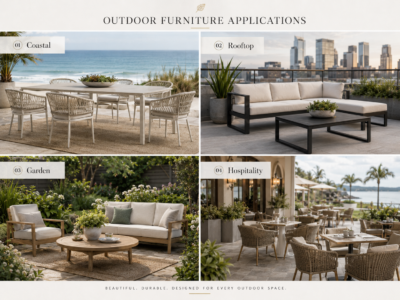
Use the table below as a practical purchasing guide. It summarizes typical priorities rather than declaring one universal winner.
| Application / Priority | Recommended | Why |
| Coastal residential area with salt exposure | Aluminum | Lower red-rust risk and less corrective maintenance |
| Windy rooftop, terrace, or café | Steel | Higher mass improves stability |
| Furniture moved or stored every day | Aluminum | Lower handling weight |
| High-frequency contract or hospitality use | Steel / engineered aluminum | Choose by tested load, fatigue performance, and joint design |
| Slim modern frame with high rigidity | Steel | Higher stiffness supports smaller-looking sections |
| Ornate cast traditional design | Cast aluminum | Casting enables integrated decorative forms |
| Budget-sensitive volume program | Steel | Strong cost-to-performance balance |
| Lowest maintenance priority | Aluminum | Less concern if minor coating damage occurs |
| Repairability and local refinishing | Steel | Often easier to straighten, weld, prime, and touch up |
Final Recommendation
The final decision should not be based on metal type alone. Aluminum is an excellent choice when low weight, frequent movement, and reduced rust risk are the main priorities. Properly pretreated and powder-coated steel is especially strong where rigidity, wind stability, slim profiles, repairability, design flexibility, and competitive project pricing matter. For many residential and commercial programs, well-engineered steel offers one of the best performance-to-cost ratios in the outdoor furniture market.